
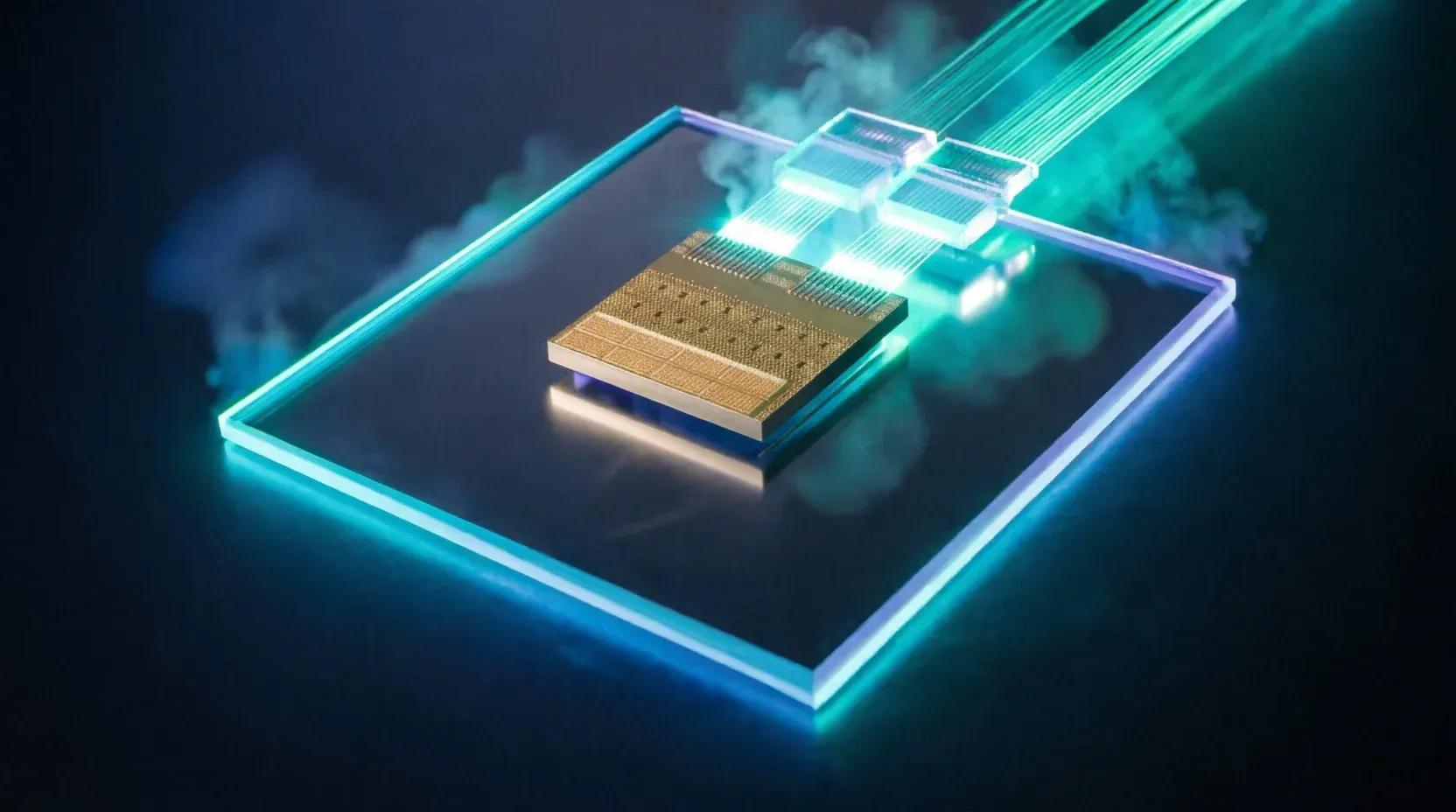
The massive scaling of AI clusters is hitting a critical bottleneck in optical connectivity, forcing a shift toward complex architectures that current supply chains struggle to support. Quintessent is positioning itself to address this by launching customer sampling of its single-chip quantum dot-based DWDM comb laser alongside a $40 million oversubscribed Series A funding round. Led by Cycle Capital, the investment includes participation from Goldman Sachs XIG-Industry Ventures, Ciena, and Susquehanna International Group. This capital injection aims to transition the Santa Barbara-based company from pure technology development into a product-focused entity capable of meeting the urgent demand for efficient, high-volume optical interconnects in the rapidly expanding AI datacenter market.
Quintessent $40M Series A and Comb Laser Sampling
Quintessent is leveraging its $40 million Series A to move its quantum dot-based DWDM comb laser from demonstration to active customer integration. The company has officially commenced customer sampling, offering the technology via an evaluation kit (QCOMB-1310-08-08-200-EVK) to allow users to integrate the laser into system test beds. This milestone follows the initial unveiling of the technology at OFC 2026. The funding, which saw participation from several new and existing investors including Hina Liberty Capital and M Ventures, is earmarked for the maturation of the comb laser, reliability qualification, and the ramping of manufacturing processes.
Beyond the immediate sampling phase, Quintessent is utilizing the proceeds to expand its product roadmap. The company plans to develop additional critical optical components, specifically semiconductor optical amplifiers (SOAs), and intends to begin work on an optical engine designed for high reliability, availability, and serviceability (RAS) pluggable module interconnect applications. By targeting these specific components, Quintessent is attempting to build a broader ecosystem of optical connectivity technologies. This strategic expansion aims to provide a more comprehensive suite of solutions for the AI infrastructure buildout, moving from individual enabling components toward fully integrated optical interconnect solutions that can support the massive data movement requirements of modern AI clusters.
Addressing InP Shortages and DWDM Complexity
The company’s technical approach targets two primary friction points in current AI infrastructure: the complexity of Dense Wavelength Division Multiplexing (DWDM) and the global shortage of Indium Phosphide (InP) lasers. As the industry converges on wide-and-parallel DWDM architectures for optical scale-up networks, the requirement for laser sources is increasing by orders of magnitude. Quintessent’s comb laser architecture generates eight precisely spaced wavelengths from a single laser using a single bias control. This design eliminates the need for banks of individually tuned lasers, high-power pump lasers, or complex wavelength-control electronics, which the company claims can lead to a 40% reduction in data movement power compared to "narrow-and-fast" architectures.
To bypass the capacity-constrained InP supply chain, Quintessent is utilizing Gallium Arsenide (GaAs) O-band quantum dot gain material. This material system is described as a mature, high-volume option that can be heterogeneously integrated on standard silicon photonics. This integration is intended to enable high-volume, wafer-scale manufacturing, providing a more resilient supply chain for the AI era. By consolidating multiple lasers into one and reducing the total component count, the architecture is designed to simplify manufacturing and improve reliability while lowering the total cost of ownership for datacenter operators.
Key Takeaways
- Quintessent raised $40 million in an oversubscribed Series A round led by Cycle Capital to scale its AI optical interconnect technologies.
- The company has begun customer sampling of its single-chip quantum dot-based DWDM comb laser via an evaluation kit.
- The architecture utilizes Gallium Arsenide (GaAs) to avoid reliance on the constrained Indium Phosphide (InP) supply chain.
TechInsyte's Take
In our view, Quintessent is making a calculated bet that the primary constraint on AI scaling will not be compute power, but the physical and economic limits of moving data between chips. By moving away from Indium Phosphide and toward Gallium Arsenide, the company is not just offering a performance upgrade; it is attempting to solve a fundamental supply chain vulnerability that threatens the entire AI hardware roadmap. If their claim of a 40% reduction in data movement power holds true in production environments, this technology could become a cornerstone for hyperscalers looking to manage the escalating energy costs of massive AI clusters. However, the success of this transition from a research-heavy entity to a high-volume manufacturer will depend entirely on whether their silicon photonics integration can actually achieve the promised wafer-scale yields.
Questions & Answers
How does the Quintessent comb laser reduce power consumption in AI datacenters?
The architecture generates eight precisely spaced wavelengths from a single laser with a single bias control. By eliminating the need for multiple individually tuned lasers and complex wavelength-control electronics, the company suggests the design can enable up to a 40% reduction in data movement power compared to "narrow-and-fast" architectures.
What specific supply chain risk is Quintessent addressing with its new material choice?
The company is addressing the worldwide shortage of Indium Phosphide (InP) lasers, which are currently used in almost all optical interconnects. Quintessent uses Gallium Arsenide (GaAs) O-band quantum dot gain material, which it describes as a mature, high-volume material system that is independent of the capacity-constrained InP supply chain.
What is the current availability of the Quintessent comb laser for enterprise testing?
The technology is currently available for customer sampling in the form of an evaluation kit, identified as the QCOMB-1310-08-08-200-EVK, which allows customers to integrate the laser into their own system test beds.
What are Quintessent's planned product expansions following this funding round?
Quintessent plans to use the Series A proceeds to develop semiconductor optical amplifiers (SOAs) and to begin work on an optical engine for high reliability, availability, and serviceability (RAS) pluggable module interconnect applications within AI datacenters.
Source: Businesswire