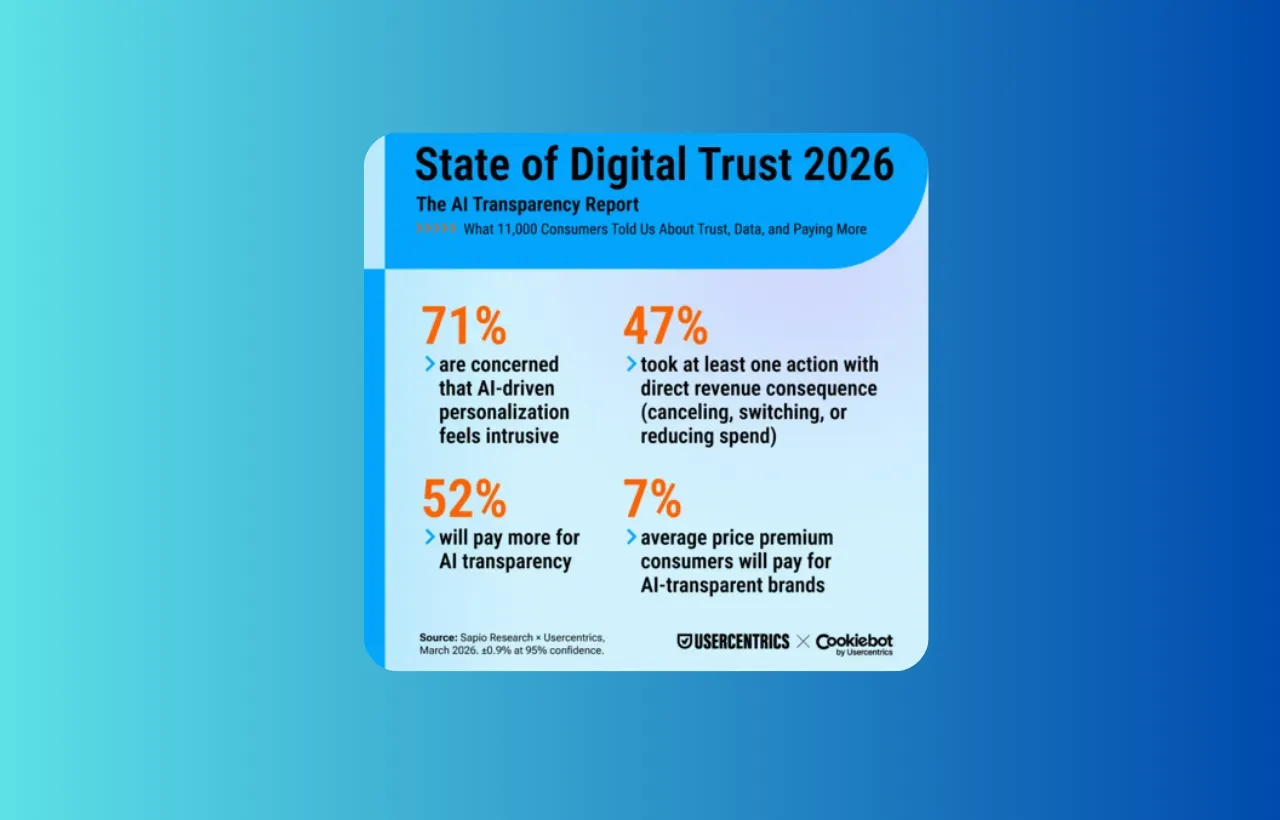
Over half of global consumers say they would pay a premium for brands that are transparent about how AI uses their data, according to Usercentrics’ State of Digital Trust 2026 report. The finding signals a growing commercial incentive for enterprises to make AI data practices visible to customers, especially in markets such as Germany where willingness to pay rises to 73 %.
Usercentrics Reveals Global Willingness to Pay a Premium for AI Transparency
The second‑annual State of Digital Trust 2026 report, commissioned by data‑privacy platform Usercentrics and conducted by Sapio Research, surveyed 11,000 consumers across seven markets in March 2026. Overall, 52 % of respondents indicated they would pay an average 7 % premium for brands that disclose how AI processes their data. In Germany, the willingness climbs to 73 % of consumers, who would pay an average 9 % premium—the highest level reported in any market.
The study also measured concrete consumer actions linked to AI data concerns. Nearly half (47 %) of respondents said they had taken at least one revenue‑impacting step in the past six months—cancelling a subscription, switching to a competitor, or reducing spend—because of how a brand handled AI data. For a company with one million customers, that translates to up to 240,000 purchase‑affecting decisions within six months.
Specific actions reported include:
- 35 % took two or more actions (cancellation, switch, or spend reduction)
- 24 % avoided trying a new product from the brand
- 20 % switched to a competitor perceived as more responsible with AI data
- 20 % reduced their spending with the brand
- 31 % warned friends, family, or complained publicly
Tilman Harmeling, Strategy & Market Intelligence at Usercentrics, said, “Consumers are making purchasing decisions based on how brands handle their data, and over half are willing to pay more to the ones that get it right. The brands that move first won’t just earn the premium. They’ll earn a category position that’s almost impossible to compete against once it’s established.”
Market‑Specific Findings Highlight Divergent Consumer Attitudes
The report breaks down attitudes by country, revealing notable variations:
| Market | Willingness to Pay Premium | Average Premium | Notable Consumer Action |
|---|---|---|---|
| Germany | 73 % | 9 % | 75 % have acted against a brand over AI data concerns |
| Italy | 42 % | 5 % (lowest) | — |
| Netherlands | 35 % | — | 77 % find AI‑driven personalization intrusive (highest) |
| Spain | — | — | 76 % have acted against a brand (highest) |
| Sweden* | — | — | 69 % trust banking with data (highest); 56 % lack understanding of data collection (highest) |
| United Kingdom | — | — | 80 % would stop using a service if data were misused (highest) |
| United States | 50 % | — | 39 % trust government services with data (lowest) |
*Sweden joined the study for the first time in 2026; year‑on‑year comparisons exclude Swedish data.
Additional cross‑market insights include:
- 71 % of consumers find AI‑driven personalization intrusive.
- 48 % now click “accept all” on cookie banners less often than three years ago (up from 46 % in 2025).
- Privacy‑aware consumers are nearly three times more comfortable with personalized online experiences than privacy‑unaware consumers (53 % vs. 19 %).
These figures illustrate that consumer sentiment is not uniform; regional regulatory environments and recent privacy incidents appear to shape willingness to pay and willingness to act.
Operational Implications for Enterprises
Enterprises that rely on AI for personalization, recommendation engines, or automated decision‑making should note two immediate operational considerations:
- Transparency Infrastructure – Brands will need mechanisms to disclose AI data usage in a clear, accessible format. Usercentrics’ own platform offers consent management, server‑side tagging, and AI data governance tools that can be leveraged to build such disclosures without extensive custom development.
- Risk of Revenue Leakage – The study quantifies a tangible revenue risk: for a brand with one million customers, up to 240,000 purchase‑affecting decisions could occur within six months if AI data concerns are not addressed. Companies should therefore map the customer journey to identify points where AI data handling is most visible (e.g., checkout, recommendation displays) and prioritize transparency at those touchpoints.
The report also notes three forces accelerating consumer decision‑making on AI data: the rise of agentic AI that can act on behalf of users, expanding privacy regulations (EU AI Act enforcement, U.S. state laws, UK AI governance paper), and a shift from passive acceptance to active consumer action driven by high‑profile data breaches and AI training controversies. Enterprises must align technical controls with evolving legal requirements while communicating those controls effectively to customers.
Key Takeaways
- 52 % of global consumers would pay a 7 % premium for AI‑transparent brands; the figure rises to 73 % in Germany with a 9 % premium.
- 47 % of surveyed consumers have taken at least one revenue‑impacting action (cancellation, switch, spend reduction) in the past six months due to AI data concerns.
- The study covered 11,000 consumers across seven markets; notable regional differences include the highest willingness to pay in Germany and the highest perception of intrusive personalization in the Netherlands.
TechInsyte's Take
For CIOs and CDOs, the data underscores that AI transparency is moving from a compliance checkbox to a revenue driver. While the premium consumers are willing to pay is modest, the cost of inaction—potentially hundreds of thousands of lost purchases for large customer bases—makes the business case compelling. Executives should monitor how forthcoming regulations (EU AI Act, U.S. state privacy laws) intersect with consumer expectations and be prepared to scale transparent AI disclosures across all digital touchpoints.
Source: Businesswire