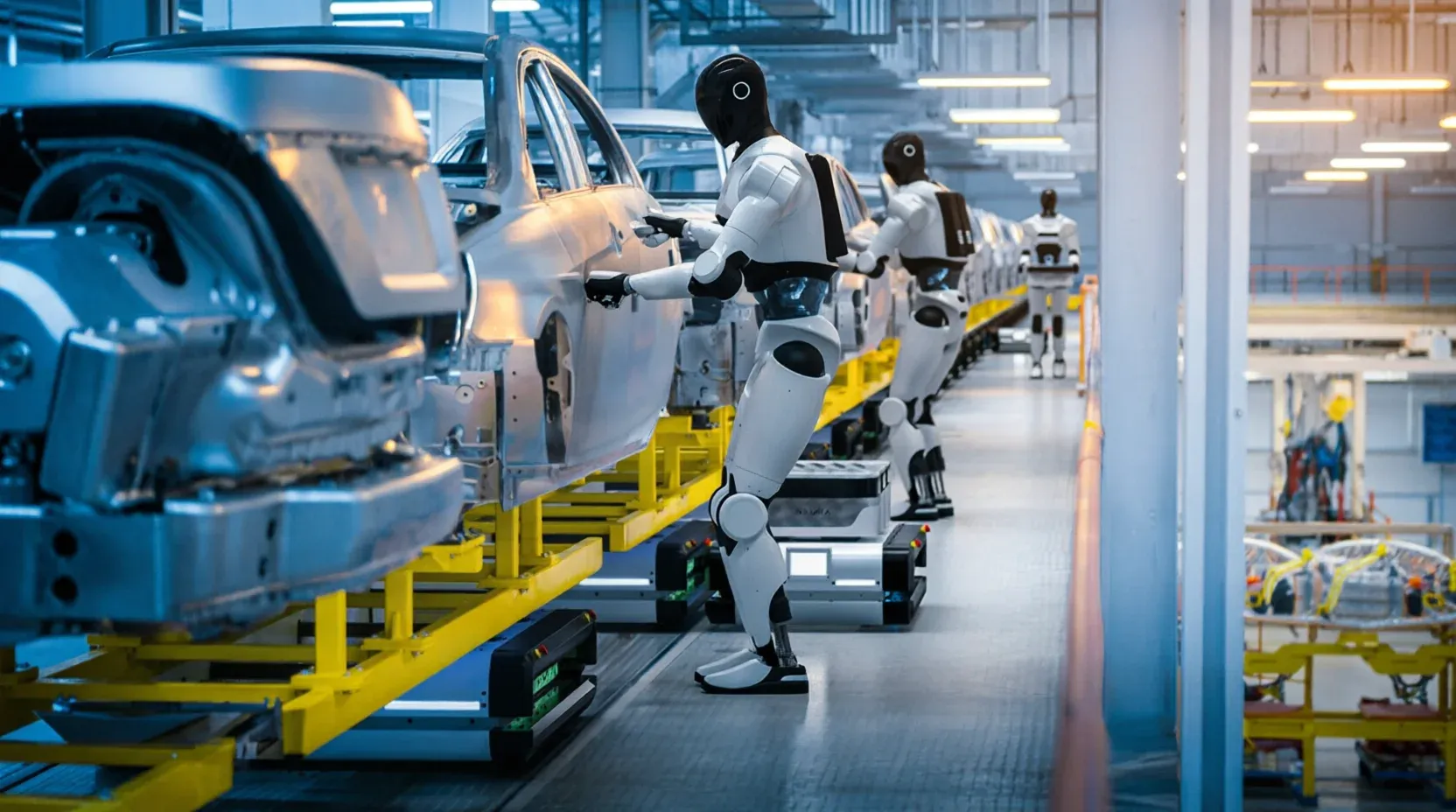
NEURA Robotics announced a landmark Series C financing round that could total $1.4 billion, the largest raise ever for a full‑stack robotics firm. The capital, sourced from a blend of technology giants, industrial manufacturers, and European investors, is earmarked for serial production, global rollout of “NEURA Gyms,” and expansion of the company’s open Physical AI ecosystem, the Neuraverse. For enterprise leaders overseeing AI, robotics, or edge‑compute initiatives, the funding signals a concerted push toward large‑scale deployment of cognitive robots that can learn and operate across real‑world environments. The announcement also underscores a broader industry belief that Physical AI—intelligence that moves beyond screens into tangible, interactive machines—will become one of the defining technology shifts of the coming decades, reshaping manufacturing, logistics, healthcare, services, and even household robotics.
NEURA Robotics Announces Record‑size Series C Funding
The financing round brings together Tether, Qualcomm Technologies, Amazon, NVIDIA, imec.xpand, Bosch, Schaeffler, the European Investment Bank, Lingotto Horizon, InterAlpen Partners, and other investors. NEURA describes the round as a “landmark” that will accelerate its mission to build the world’s leading Physical AI platform. The company’s existing orderbook and strategic deployment pipeline already exceed $1 billion, according to the announcement, reflecting contracts with major industrial customers across Europe and Asia.
Founder and CEO David Reger emphasized that the investment will fund several priorities:
- Global deployment of cognitive robots and humanoids
- Expansion of the Neuraverse platform, an open ecosystem where robots share skills and data
- Rollout of NEURA Gyms, large‑scale training environments that combine real‑world sensor interaction, simulation, and multimodal learning pipelines
- Scaling of manufacturing and deployment infrastructure to reach multi‑million robot volumes by 2030
Reger added that Physical AI “will move, interact, learn and work beside us in the real world,” positioning NEURA’s hardware‑centric approach as a new category of AI infrastructure. The round is also notable for its geographic diversity: European investors such as the European Investment Bank and imec.xpand signal strong regional confidence, while U.S. tech leaders bring cloud, compute, and chip expertise. This blend of capital is intended to support both the deep‑tech development of edge‑AI chips and the massive supply‑chain effort required to mass‑produce humanoid robots at scale.
How the Funding Fits Into the Physical AI Landscape
NEURA’s approach differs from traditional robotics firms that focus on isolated machines or narrow automation. Its Neuraverse merges robotics, AI, sensors, edge compute, and large‑scale learning into a single platform designed for global deployment. The company claims the ecosystem enables robots to continuously exchange capabilities and real‑world learning across deployments, creating one of the largest real‑world robotics data infrastructures worldwide.
Strategic partners highlighted in the release illustrate the breadth of the platform’s relevance:
- Qualcomm Technologies – EVP Nakul Duggal noted that Physical AI extends intelligence into real‑world environments and that Qualcomm’s edge AI, high‑performance computing, and connectivity will help scale NEURA’s open ecosystem.
- Amazon – VP Nafea Bshara pointed to Amazon’s cloud, AI stack (Bedrock, SageMaker), and purpose‑built chips (Trainium, Neuron) as critical infrastructure for Physical AI at scale.
- NVIDIA – While not quoted directly, NVIDIA’s participation signals alignment with high‑performance GPU compute for training and inference.
- Bosch and Schaeffler – Both industrial leaders cited sensor technology, motion conversion, and manufacturing expertise as complementary to NEURA’s humanoid robotics ambitions.
The European Investment Bank’s involvement, articulated by Vice President Nicola Beer, frames the round as part of TechEU’s effort to provide “patient capital” for mid‑cap innovators, aiming to strengthen Europe’s technological autonomy and create skilled jobs. Additional investors such as imec.xpand, Lingotto Horizon, and InterAlpen Partners bring semiconductor‑focused expertise, reinforcing NEURA’s strategy to co‑develop edge‑intelligence chips and sensor modules that will power the next generation of autonomous machines.
Collectively, these partnerships validate NEURA’s claim that the Neuraverse is not merely a software layer but a full‑stack infrastructure that spans hardware, cloud, and edge, enabling robots to learn locally, share updates globally, and operate safely in safety‑critical settings.
Operational Implications for Enterprise Buyers
The announced capital will be directed toward serial production capable of delivering multi‑million robots by 2030. For CIOs and CTOs, this timeline suggests that large‑scale procurement of cognitive robots could become a realistic option within the next decade, especially in sectors such as manufacturing, logistics, healthcare, and services where NEURA cites potential impact.
Key operational elements highlighted in the announcement include:
- NEURA Gyms – Real‑world training sites that blend physical sensor data with simulation, enabling robots to acquire multimodal skills before field deployment. Enterprises may eventually use these gyms to validate robot behavior against proprietary safety and compliance criteria.
- Open Ecosystem (Neuraverse) – By allowing robots to share learned models and capabilities, the platform could reduce the need for each buyer to develop bespoke AI pipelines. However, integration will require alignment with existing edge‑compute stacks and data‑governance frameworks.
- Edge‑First Intelligence – Tether’s CEO Paolo Ardoino referenced “QVAC” and “WDK” as components that give autonomous machines local processing and secure financial transaction capabilities. While the specifics were not disclosed, the mention suggests future support for on‑device decision‑making and audit‑ready transaction logs—features relevant to regulated industries.
The company did not disclose further technical specifications, pricing models, or detailed rollout schedules beyond the 2030 production target, leaving enterprise buyers to monitor forthcoming developer previews and pilot programs for concrete integration pathways.
What to Watch Next
- NEURA Gyms rollout schedule – The first public NEURA Gym is slated for Q4 2024 in Germany’s Ruhr Valley. Watch for announcements on partner participation and certification processes that could affect early‑adopter programs.
- Neuraverse SDK releases – NEURA has promised a developer preview of its open‑source SDK in early 2025. The breadth of supported edge‑compute frameworks (Qualcomm Snapdragon, NVIDIA Jetson, Amazon Graviton) will be a key indicator of how easily enterprises can plug the platform into existing AI pipelines.
- Regulatory and safety standards – As cognitive robots move toward multi‑million‑unit production, alignment with ISO 10218‑1/2, ISO/TS 15066, and emerging EU AI Act provisions will become critical. NEURA’s “WDK” audit‑ready logs may become a differentiator for regulated sectors such as healthcare and finance.
- Supply‑chain resilience – With Bosch and Schaeffler on board, monitor how NEURA secures critical components (actuators, sensors, power modules) amid global semiconductor constraints. Any bottlenecks could impact the 2030 volume target.
Key Takeaways
- NEURA Robotics raised up to $1.4 billion in a Series C round, the largest ever for a full‑stack robotics company.
- The funding will support serial production of multi‑million robots by 2030 and the global expansion of NEURA Gyms, large‑scale real‑world training environments.
- NEURA’s ecosystem, the Neuraverse, now includes investors such as Qualcomm, Amazon, NVIDIA, Bosch, Schaeffler, and the European Investment Bank, indicating broad cross‑industry backing for Physical AI.
TechInsyte's Take
The financing underscores a shift from isolated automation toward an open, data‑rich robotics infrastructure that can be scaled globally. While the roadmap to multi‑million robot volumes is ambitious, the depth of industrial and cloud partner involvement suggests the necessary compute and sensor capabilities are being aligned. Enterprise leaders should monitor NEURA’s progress on NEURA Gyms and edge‑first intelligence components, as these will determine how readily the platform can integrate with existing AI and compliance stacks.
Source: Businesswire