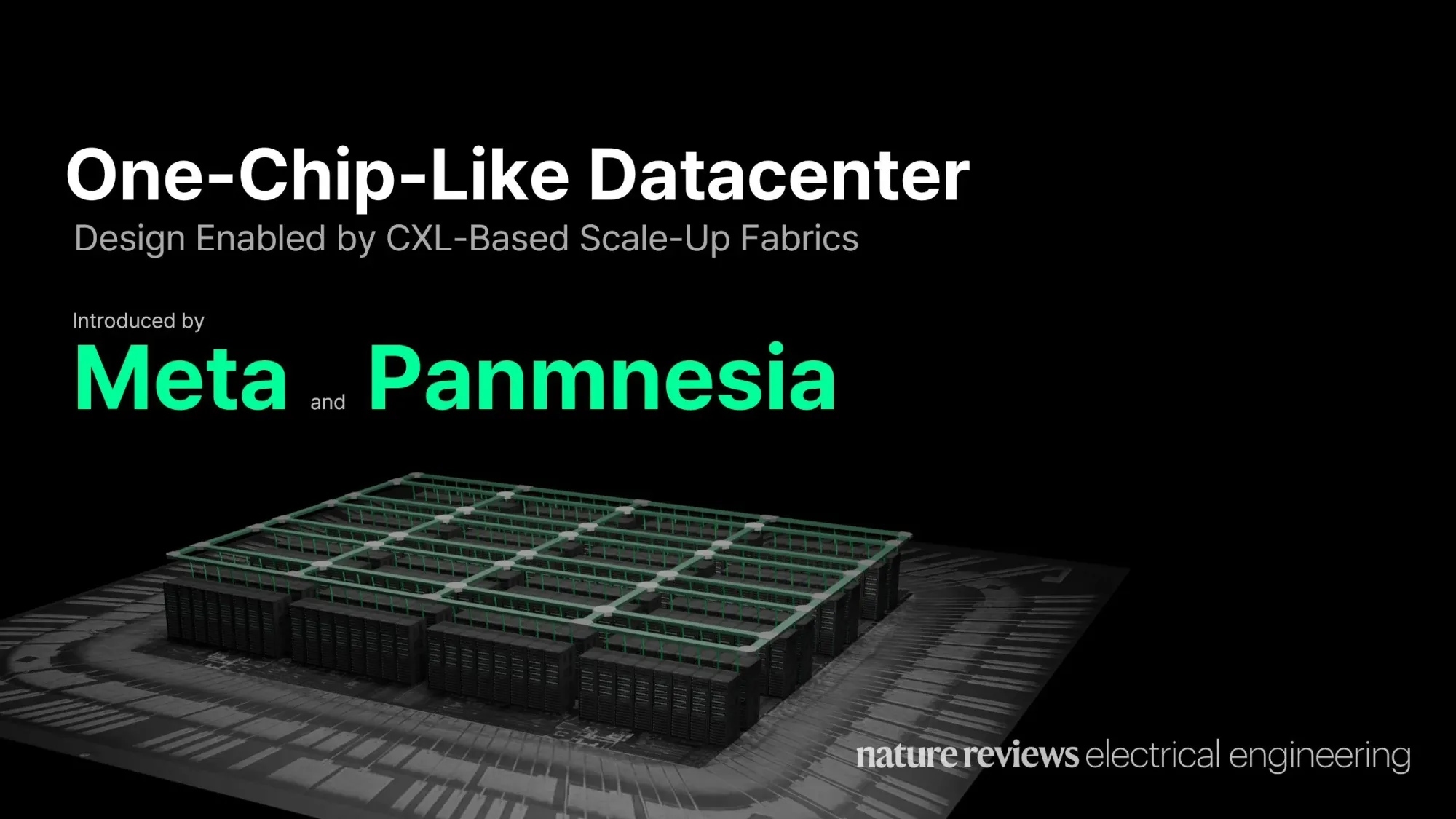
Meta and fabless semiconductor startup Panmnesia have jointly proposed a next-generation data center architecture designed to eliminate cross-rack latency bottlenecks by allowing an entire facility to operate as a single computing environment. Published as an invited Review in Nature Reviews Electrical Engineering (NREE), the research leverages the Compute Express Link (CXL) standard to extend tight hardware coupling beyond the traditional rack level.
As AI models scale into trillions of parameters, training workloads require thousands of accelerators to exchange terabytes of data. However, the system's overall speed is dictated by its slowest participant. The Meta and Panmnesia research targets this bottleneck, aiming to reduce the latency variance that frequently delays large-scale AI jobs.
Eliminating Cross-Rack Stragglers in AI Training
Within a modern AI rack, components are already tightly coupled through dedicated high-speed interconnects. However, the connection between racks relies heavily on general-purpose networks like Ethernet or InfiniBand. In these setups, each request must pass through a network interface and a software-based coordination layer, widening the latency spread and making job completion times difficult to predict.
The architecture proposed by Meta and Panmnesia attempts to bring the predictability of a single chip to the cross-rack segment. By placing CPUs, accelerators, and memory into a single CXL-based domain, the design extends cache coherence from within the individual rack to the data center as a whole.
A Data Center-Wide Coherence Domain
The architecture is built on three specific hardware elements designed to bind latency variability:
- A high-fan-out non-blocking switch
- A link acceleration unit (LAU)
- A fabric controller
To overcome the physical reach limits of standard electrical signaling across a data center, the proposed design also integrates CXL-over-optics to extend the fabric's reach. The resources are laid out using the same fundamental principles that govern the placement of functional blocks inside a single processor.
According to the research, this approach yields significant scale and speed improvements over conventional rack-scale configurations. Using a baseline of one CPU coupled to two accelerators, the proposed architecture allows a single CPU to coordinate 16 accelerators—an eightfold increase. The unified coherence domain can scale to operate as many as 960 accelerators as a single execution unit, roughly 13 times the reference platform.
By replacing network traversal with fixed CXL paths, round-trip latency drops from the microsecond range to several hundred nanoseconds, an improvement of up to an order of magnitude.
Changing Hardware Lifecycle and Failure Management
Beyond performance, the disaggregated architecture alters infrastructure maintenance. In a tightly coupled, single-chip-like data center, the unit of replacement after a hardware failure narrows from an entire server to a single isolated device.
According to Panmnesia CEO Myoungsoo Jung, efficient resource connection is now as critical as individual accelerator performance. Panmnesia noted that it has already implemented the architecture's core components in silicon, completed validation, and is preparing the hardware for commercial supply.
TechInsyte's Take
Network overhead and cross-rack latency have become the primary governors on AI cluster performance. While proprietary interconnects currently dominate intra-rack scaling, extending those speeds across an entire facility traditionally requires expensive network topologies and risks vendor lock-in.
By building on the open CXL standard, Meta and Panmnesia are demonstrating a pathway to democratize high-bandwidth, low-latency scaling. If this architecture can be successfully commercialized at scale, treating a data center as a unified silicon floorplan could fundamentally shift how hyperscalers provision AI hardware. It moves the industry away from monolithic, static servers toward highly disaggregated, composable resource pools where memory and compute can be dynamically assigned without software-induced network delays.
Q&A
What is the primary bottleneck this architecture addresses?
It addresses cross-rack latency variability. Currently, data exchanged between racks must traverse general-purpose networks (like Ethernet or InfiniBand) and software layers, which creates delays. This architecture uses CXL to create a fixed path, operating the data center like a single chip.
How does the CXL-based design improve accelerator scaling?
Compared to a conventional reference platform, the architecture increases the number of accelerators a single CPU can coordinate from two to 16. It also expands the unified coherence domain to support up to 960 accelerators operating as a single unit.
What specific hardware is required for this CXL architecture?
The core architecture relies on three hardware elements: a high-fan-out non-blocking switch, a link acceleration unit (LAU), and a fabric controller. It also utilizes optical links (CXL-over-optics) to overcome the physical distance limits of electrical signals.
How does this impact hardware failures?
Because the architecture disaggregates resources across a CXL fabric, the unit of replacement after a failure narrows from replacing a whole server to simply replacing the single failing device..
Source: Businesswire