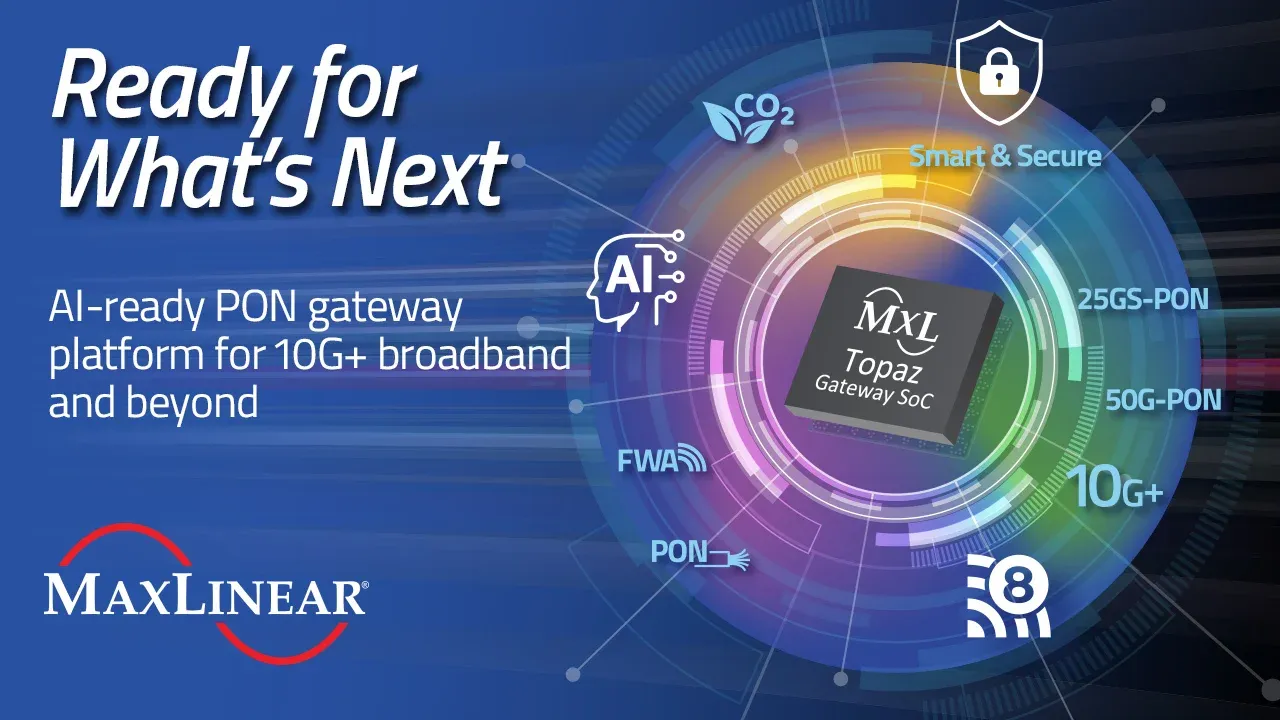
MaxLinear is positioning itself to capture the shift toward intelligent, high-bandwidth residential and business connectivity by integrating AI acceleration and post-quantum security directly into the edge. The company has announced Topaz, a highly integrated System-on-Chip (SoC) designed to power next-generation Passive Optical Network (PON) Home Gateway Units (HGUs). By consolidating fiber access, packet processing, and machine learning engines into a single silicon footprint, MaxLinear aims to help operators deploy 10G broadband services while addressing the rising computational demands of AI-driven applications and evolving global cybersecurity mandates.
Topaz Architecture and 10G Broadband Integration
The Topaz SoC is engineered to serve as a central processing hub for 10G broadband deployments, offering a scalable architecture that the company suggests can extend to 25G and 50G connectivity. Unlike traditional multi-processor architectures that require separate components for various functions, Topaz integrates multi-gigabit fiber access, packet routing, and AI/ML acceleration onto one chip. This consolidation is intended to reduce the Bill of Materials (BOM) costs for Original Equipment Manufacturers (OEMs) and decrease the physical design footprint of gateway hardware.
To support the high-throughput requirements of modern networks, the platform includes DDR5 memory support and low-latency packet processing capabilities. MaxLinear is specifically targeting the infrastructure requirements of Wi-Fi 8, providing the necessary memory bandwidth and interconnect speeds to manage dense, multi-gigabit traffic. Furthermore, the chip incorporates Dynamic Power Management (DPM) technology and integrated PHYs to scale energy consumption based on real-time traffic loads. This feature is designed to assist operators in meeting sustainability goals and energy efficiency mandates by minimizing power draw during idle periods while maintaining line-rate responsiveness.
Unified Software and Post-Quantum Security Readiness
MaxLinear is leveraging a "unified platform" strategy, known as AnyWAN, to bridge the gap between different access technologies. By sharing a common hardware and software foundation with the company's Puma 9 DOCSIS platform, Topaz allows for significant code and feature reuse across Cable, Fiber, Ethernet, and Fixed Wireless Access (FWA) product portfolios. This approach is intended to shorten software development cycles and simplify portfolio management for operators transitioning between different network architectures.
Security is a primary pillar of the Topaz design, which the company describes as "secure-by-design." The SoC includes hardware-based readiness for post-quantum cryptography (PQC) to defend against emerging cyber threats over the long lifecycles typical of fiber infrastructure. Additionally, the platform is built to support compliance with major regulatory frameworks, including the U.S. NIST IR 8425A, the EU’s Radio Equipment Directive (RED), and the Cyber Resilience Act (CRA). To ensure interoperability, the architecture supports open standards such as the prpl Foundation’s prplWare and RDK, facilitating application portability across diverse hardware environments.
Key Takeaways
- The Topaz SoC integrates 10G PON fiber access, AI/ML acceleration, and post-quantum cryptography (PQC) readiness into a single chip.
- MaxLinear utilizes an "AnyWAN" approach, sharing a common architecture with its Puma 9 DOCSIS platform to enable code reuse across Cable, Fiber, and FWA.
- The platform includes hardware-based support for L4S and Dual-Queue AQM to optimize low-latency networking and packet processing.
TechInsyte's Take
In our view, MaxLinear’s move to integrate AI/ML engines directly into the PON gateway SoC is a strategic response to the "intelligence at the edge" trend. As broadband consumers shift from simple data consumption to hosting AI-driven smart environments, the gateway can no longer function as a simple pass-through device; it must become a compute-capable node. By embedding these capabilities alongside post-quantum security, MaxLinear is attempting to solve two of the most significant long-term headaches for service providers: the massive power requirements of high-speed hardware and the looming threat of quantum-enabled decryption. The "AnyWAN" strategy is equally critical, as it provides a hedge against the fragmented nature of global access technologies, allowing OEMs to maintain a more streamlined, cost-effective development pipeline regardless of whether the end-user is on fiber or cable.
Questions & Answers
How does the Topaz SoC address the increasing power demands of 10G networks?
The SoC utilizes integrated PHYs and Dynamic Power Management (DPM) technology. This allows the chip to dynamically scale its energy consumption based on real-time traffic loads, minimizing power during idle periods while ensuring the device can maintain instant line-rate responsiveness when traffic spikes.
What strategic advantage does the "AnyWAN" approach provide to operators?
The AnyWAN approach uses a common architecture shared with MaxLinear's Puma 9 DOCSIS platform. This enables significant reuse of code, features, and development resources across Cable, Fiber, Ethernet, and Fixed Wireless Access (FWA) portfolios, which can shorten software development cycles and reduce long-term engineering and support costs.
In what ways is the Topaz platform prepared for future cybersecurity threats?
Topaz incorporates hardware-based readiness for post-quantum cryptography (PQC) to address emerging threats. It is also designed to comply with major international cybersecurity regulations, including the EU’s Cyber Resilience Act (CRA), the Radio Equipment Directive (RED), and the U.S. NIST IR 8425A.
How does Topaz support the transition to Wi-Fi 8 and low-latency services?
The platform provides the high processing performance, memory bandwidth, and interconnect speeds required for Wi-Fi 8. Additionally, it features an upgraded packet processing engine with hardware-based dual-queue AQM implementation for L4S, which is designed to minimize packet delay and bridge the gap between new services and network infrastructure.
Source: MaxLinear