
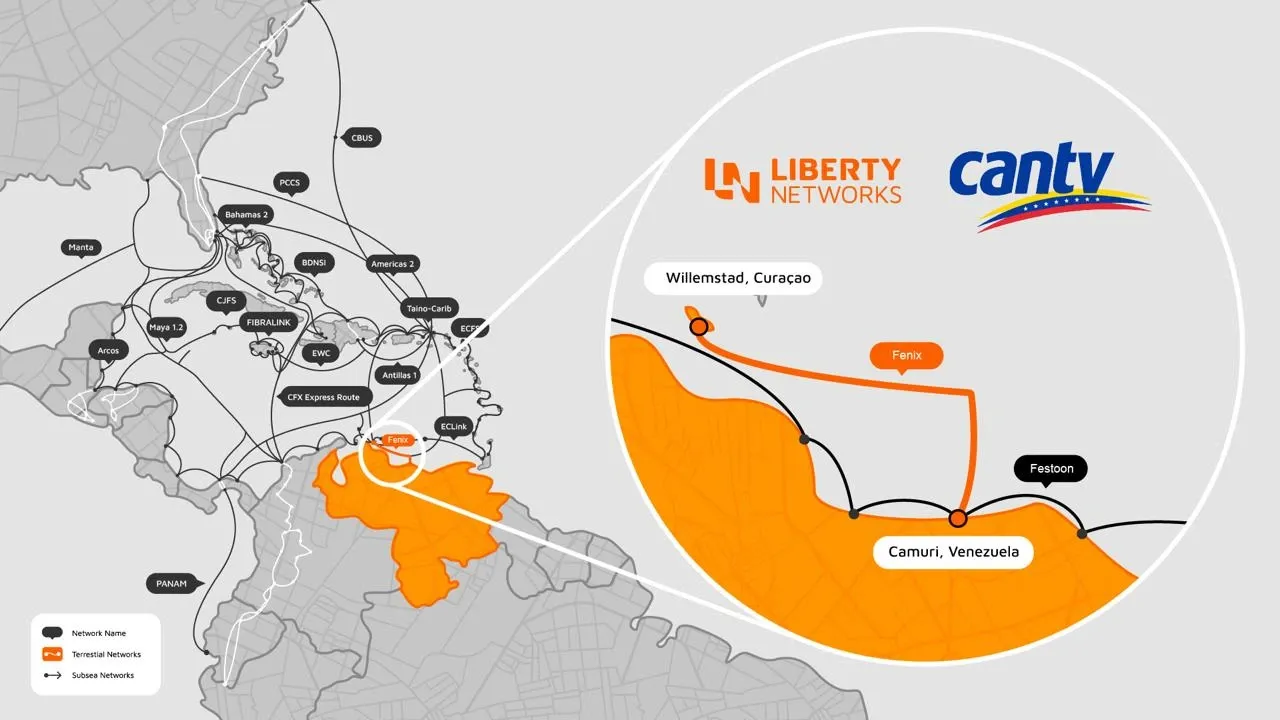
Liberty Networks and Compañía Anónima Nacional Teléfonos de Venezuela (CANTV) have launched Fénix, a new submarine cable system designed to strengthen international connectivity for Venezuela. The project establishes a critical link between Camuri, Venezuela, and Willemstad, Curaçao, integrating Venezuela into a broader regional digital infrastructure. For B2B decision-makers and infrastructure operators, this development signals a strategic increase in capacity and route diversity, potentially reducing latency for digital content delivery and enhancing the resilience of data transport between Venezuela and global traffic hubs.
Fénix System Specifications and Technical Integration
The Fénix submarine cable system extends 378 km and provides a minimum ring capacity of 14 Tbps in each direction. It utilizes two primary landing points: Camuri, situated roughly 50 kilometers from Caracas, and Willemstad in Curaçao. To ensure high-performance data transport, the project deploys next-generation Submarine Line Terminal Equipment (SLTE), which supports 100G and 400G interfaces and allows for flexible spectrum loading. This technical framework is designed to provide a latency of less than 4 milliseconds to Curaçao.
Fénix integrates directly into CANTV's Festoon submarine cable and connects to Liberty Networks' IP hub in Curaçao. This hub is further supported by the Arcos, EC-Link, Jerry Newton, and PCCS submarine systems. This architecture provides the necessary route diversity and high availability required for enterprise-grade resilience. Additionally, the integration includes IP Transit capabilities from Curaçao to the NAP of the Americas in Miami, one of the world's most significant traffic exchange points, ensuring optimal network operation and the provision of associated digital services.
Strengthening Venezuela's International Digital Infrastructure
The deployment of Fénix addresses a critical geographic need, as the capital region of Venezuela concentrates more than 40% of the country's international traffic volume. By establishing a new interconnection point in the Capital region, the project diversifies the paths through which data enters and exits the country. This system complements existing infrastructure, including the ARCOS-1 east and west systems at the Punto Fijo landing station and border interconnection points in Cúcuta and Maicao.
These border points interconnect with landing stations in Cartagena, where Liberty Networks currently operates three submarine cables. According to Ray Collins, CEO of Liberty Networks, the project is a fundamental step in offering greater capacity and access to a key region for Venezuela's digital development. Engineer Colmenares M. of CANTV noted that the system generates significant capacity to meet current national needs. The combination of these diverse routes—spanning from the Caribbean islands to the Colombian border—is positioned to raise the overall quality of the user experience by drastically reducing latency to relevant digital content.
Key Takeaways
- The Fénix cable system spans 378 km with a minimum ring capacity of 14 Tbps and latency under 4 milliseconds to Curaçao.
- Infrastructure includes next-generation SLTE equipment supporting 100G and 400G interfaces for flexible spectrum loading.
- Connectivity is routed through the Curaçao hub to the NAP of the Americas in Miami via Liberty Networks' regional ecosystem.
TechInsyte's Take
In our view, the Fénix project is less about a single cable and more about the strategic creation of redundancy for a high-traffic corridor. By linking Caracas's concentrated traffic to the Curaçao hub and the NAP of the Americas, Liberty Networks and CANTV are mitigating the risks associated with single-point failures in Venezuelan connectivity. This signals that the region is moving toward a more resilient, diversified architecture that mirrors global enterprise standards. For operators, the shift to 400G-ready interfaces suggests a forward-looking capacity plan intended to handle significant growth in data demand over the next several years.
Source: BUSINESSWIRE