The increasing mobility of sensitive enterprise data necessitates a shift from software-dependent security to dedicated hardware-based protection to mitigate the risks of physical theft and unauthorized access. As professionals move between home, office, and remote environments, the vulnerability of portable USB drives to malware and loss grows. Kingston Technology is positioning its Kingston IronKey portfolio as a strategic response to these risks, emphasizing that effective data protection requires more than simple encryption labels. The company argues that organizations must prioritize hardware-based microprocessors and recognized security certifications to ensure that sensitive files remain unreadable even if a device is lost or connected to an untrusted host.
Kingston IronKey Security Criteria and Hardware Architecture
To address the limitations of standard software encryption, which can be vulnerable to system malware and software-based attacks, Kingston is advocating for "always-on" hardware-based encryption. This approach utilizes a dedicated, built-in secure microprocessor to automate the encryption and decryption process. By employing industry-standard XTS-AES 256-bit hardware encryption, the device keeps encryption keys securely contained within the hardware itself, preventing users from accidentally or intentionally bypassing data protection protocols. This architecture ensures that files are encrypted immediately upon being saved to the drive.
Beyond the core encryption engine, Kingston identifies several advanced protection layers necessary for enterprise-grade resilience. These include brute-force attack protection, which can trigger a data erase after repeated failed password attempts, and BadUSB protection designed to defend against malicious firmware tampering. For organizations managing complex access requirements, the company highlights the importance of multi-password options, such as separate Administrator and User access, to facilitate data recovery without compromising overall security. Additionally, dual read-only modes are positioned as a method to prevent unauthorized data modification when drives are connected to untrusted or public computing systems.
Segmented Deployment Models for Enterprise Use Cases
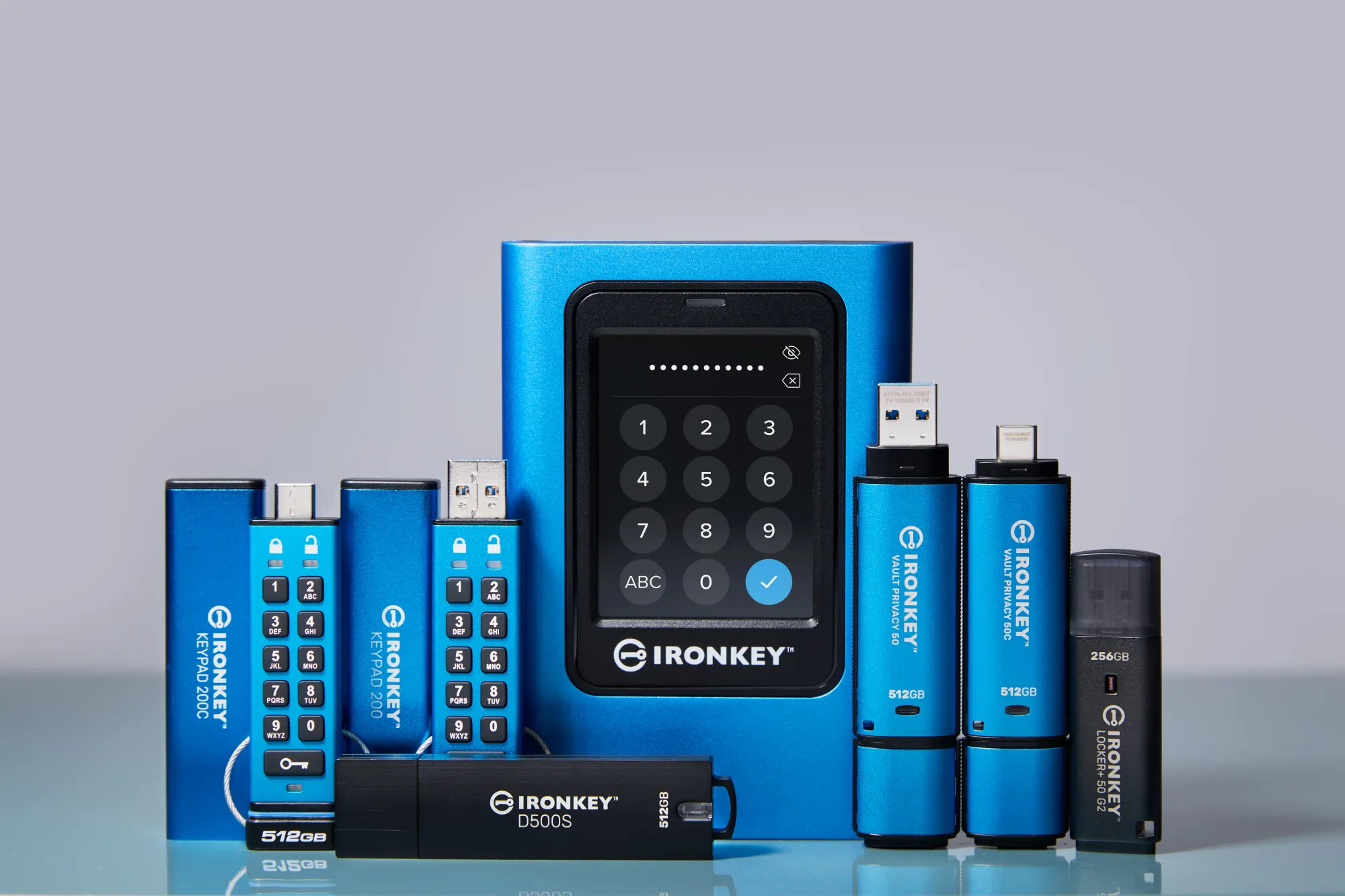
Kingston is categorizing its IronKey portfolio into specific deployment models based on the sensitivity of the data and the regulatory environment of the user. For remote workers and freelancers managing client deliverables, the IronKey Vault Privacy 50 Series offers XTS-AES 256-bit encryption with multi-password recovery options. In contrast, professionals operating in specialized medical or industrial environments may require the IronKey Keypad 200 Series, which features an alphanumeric keypad for PIN-based access. This allows for OS-independent operation, meaning the drive can be unlocked without requiring any software installation on the host machine.
For high-capacity requirements, such as offline disaster recovery backups for small to medium-sized businesses, the IronKey Vault Privacy 80 External SSD provides capacities up to 8TB via a touchscreen interface. However, for highly regulated sectors like finance, healthcare, and government, the company points to the IronKey D500S USB Flash Drive. This model is designed to meet stringent procurement and security mandates, featuring FIPS 140-3 Level 3 validation, TAA compliance, and MIL-STD-810F military-standard ruggedization. These specifications are intended to support organizations that must adhere to strict supply-chain regulations and data privacy laws.
Key Takeaways
- Kingston advocates for XTS-AES 256-bit hardware-based encryption to prevent the vulnerabilities associated with software-only encryption methods.
- The IronKey D500S is designed for regulated industries, featuring FIPS 140-3 Level 3 validation, TAA compliance, and MIL-STD-810F military-standard construction.
- Advanced security features across the portfolio include brute-force attack protection, BadUSB protection, and multi-password access for administrators and users.
TechInsyte's Take
In our view, Kingston’s detailed breakdown of encryption tiers signals a growing recognition that "one-size-fits-all" security is no longer viable in a decentralized work environment. By differentiating between simple hardware encryption for students and FIPS 140-3 Level 3 validated hardware for government contractors, Kingston is acknowledging that the threat model changes based on the user's regulatory obligations. This move highlights a critical trend in enterprise IT: the necessity of moving security closer to the data itself. As the perimeter continues to dissolve, relying on host-machine software to protect portable assets is a high-risk strategy. For CIOs, the implication is clear: portable storage must be treated as a managed endpoint with specific hardware requirements, rather than a generic commodity, to ensure both compliance and technical resilience against sophisticated firmware and brute-force attacks.
Questions & Answers
How does hardware-based encryption differ from software-based encryption in an enterprise context?
Hardware-based encryption utilizes a dedicated, built-in secure microprocessor to manage encryption keys and processes, whereas software encryption relies on the host computer's operating system. Kingston suggests that hardware-based methods are more resilient because they are not susceptible to the same system malware and software attacks that can compromise software-only solutions.
What specific certifications should IT leaders look for when procuring secure portable storage?
For highly regulated environments, IT leaders should prioritize devices that meet recognized standards such as NIST FIPS 140-3 (specifically Level 3 for higher security) and TAA compliance. TAA compliance is particularly critical for U.S. federal and defense procurement, as it indicates a trusted and verified supply chain.
Can hardware-encrypted drives be used on systems without specialized software installation?
Yes, certain models like the IronKey Keypad 200 Series allow for OS- and device-independent operation. By using an alphanumeric keypad for PIN-based access, users can unlock the drive directly on the hardware, allowing it to be used on compatible USB-enabled systems without requiring any software installation on the host machine.
What features protect against physical tampering and unauthorized digital access?
To mitigate these risks, Kingston offers features such as brute-force attack protection (which can erase data after failed attempts), BadUSB protection against firmware tampering, and ruggedized physical builds like the epoxy-filled, zinc-cased D500S, which is built to MIL-STD-810F military standards.
Source: Businesswire