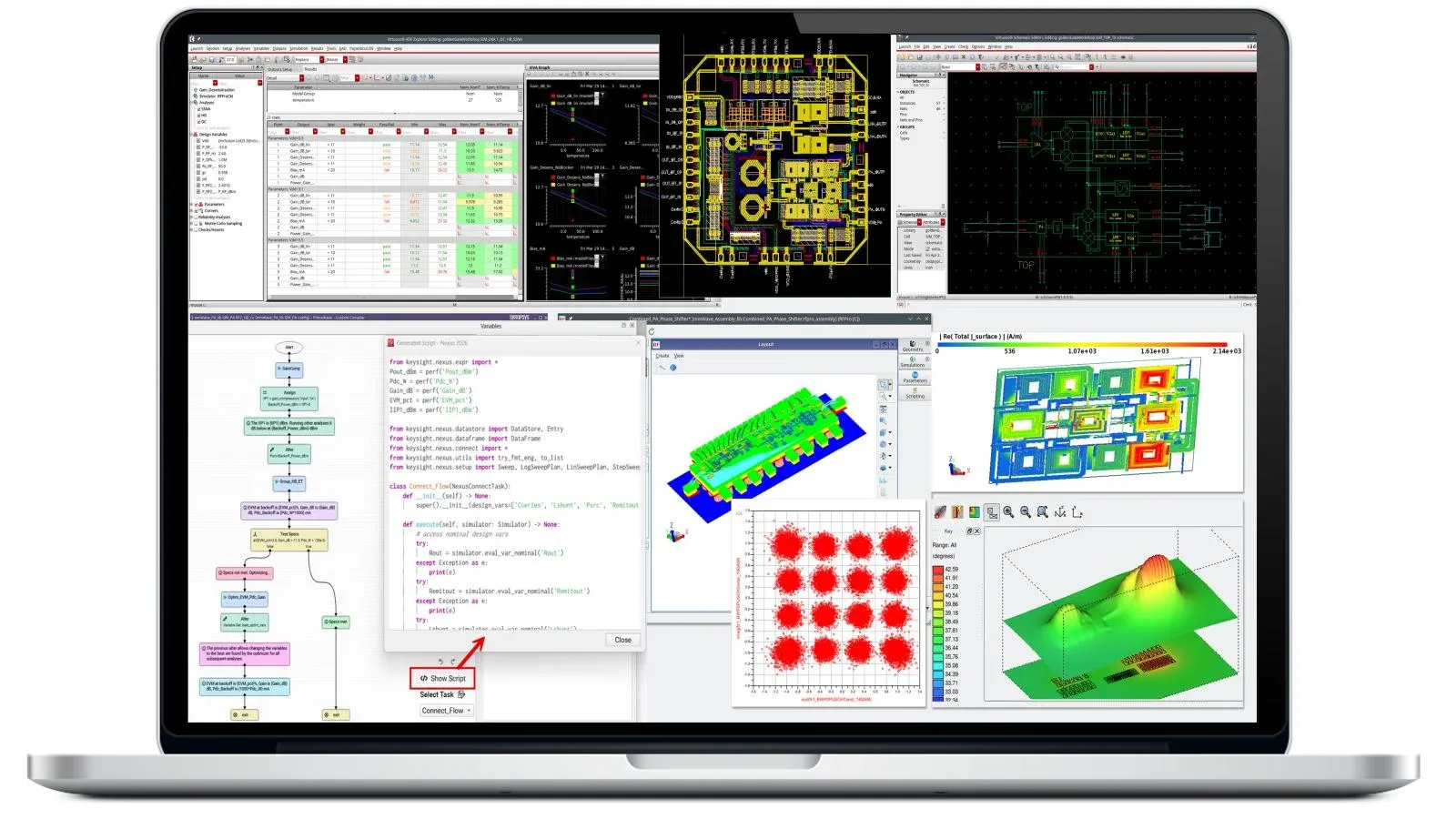
Keysight Technologies is attempting to bridge the gap between generative AI capabilities and the highly specialized requirements of radio frequency (RF) engineering. By integrating agentic AI into its Advanced Design System (ADS) 2027, the company aims to automate complex design tasks through autonomous agents. This move targets a specific bottleneck in RF development, where traditional large language models (LLMs) struggle to interpret schematics and layouts deterministically. For enterprise engineering teams, this integration suggests a shift toward automated design, verification, and optimization workflows.
Automating RF Workflows via ADS 2027
The introduction of agentic AI into the ADS 2027 and RF Circuit Simulation Professional platforms addresses the inherent difficulty of applying LLMs to RF engineering. Because RF design relies on specialist expertise and non-textual layouts, Keysight is deploying Model Context Protocol (MCP) servers to connect AI agents directly to its software. These servers provide agents with documented skills and tools that execute specific RF tasks with consistency, which the company says helps reduce the variability typically caused by statistical AI inference.
Engineers can now use natural language to direct agents to perform tasks within the software. To facilitate this, ADS 2027 allows teams to record workflows as macros, which agents can then learn from and utilize. Furthermore, the software can convert graphical designs into code that LLMs can process. This technical framework is designed to allow agents to handle repetitive setup and simulation steps, theoretically enabling engineers to evaluate a higher volume of design options within existing development timelines.
Bridging LLM Limitations with Simulation
Keysight is positioning its software as a validation layer for autonomous AI agents. While LLMs can generate and optimize designs based on user prompts, the company emphasizes that Keysight simulation is used to validate the progress and accuracy of these agents. This creates a closed loop where the agent proposes a design, and the simulation environment verifies its physical viability before it reaches the hardware stage.
The company is also building an open ecosystem around these agentic workflows. The MCP servers are designed to work with AI assistants and LLMs that organizations are already utilizing, potentially allowing for multi-vendor tool integration within a single workflow. By capturing experienced engineers' methods through macro recording, Keysight suggests that prior projects can be converted into "organizational intelligence" that agents can reuse. This capability aims to preserve domain expertise and distribute it across broader engineering teams through automated, repeatable processes.
Key Takeaways
- Keysight has released MCP servers in ADS 2027 and RF Circuit Simulation Professional to connect AI agents to RF design tools.
- The software enables the conversion of graphical designs into code and the recording of workflows as macros for agent learning.
- More than 60% of organizations reportedly expect to deploy AI agents by 2028, according to the company.
TechInsyte's Take
In our view, Keysight is making a calculated move to prevent AI from becoming a liability in high-precision RF environments. The primary risk with standard LLMs in engineering is their tendency toward statistical guesswork, which is unacceptable in radio frequency design. By layering MCP servers and mandatory simulation validation over the AI agent, Keysight is attempting to enforce determinism on a non-deterministic technology. This signals a broader trend in enterprise software: the value is shifting from the AI model itself to the "guardrail" infrastructure that ensures AI outputs meet rigorous physical and mathematical standards.
Questions & Answers
How does Keysight address the non-deterministic nature of AI in RF engineering?
Keysight utilizes Model Context Protocol (MCP) servers to provide agents with documented, specific tools and skills. This allows the agents to execute RF work consistently, while Keysight simulation is used to validate the agent's outputs, ensuring they meet required technical standards.
What role do macros play in the new agentic workflow?
Engineers can record their specific workflows as macros within ADS 2027. These macros serve as a training mechanism, allowing AI agents to learn and replicate experienced engineers' methods across the organization.
Can these AI agents work with existing enterprise AI tools?
Yes. Keysight is positioning its MCP servers to work with the AI assistants and LLMs that organizations are already using, aiming to create an open ecosystem that supports multi-vendor workflows.
What is the primary functional benefit for engineering teams?
The integration aims to speed up design cycles by allowing agents to handle repetitive setup and simulation tasks. This enables engineers to cover more design scenarios and find more optimal designs within the same development timeframe.
Source: Keysight