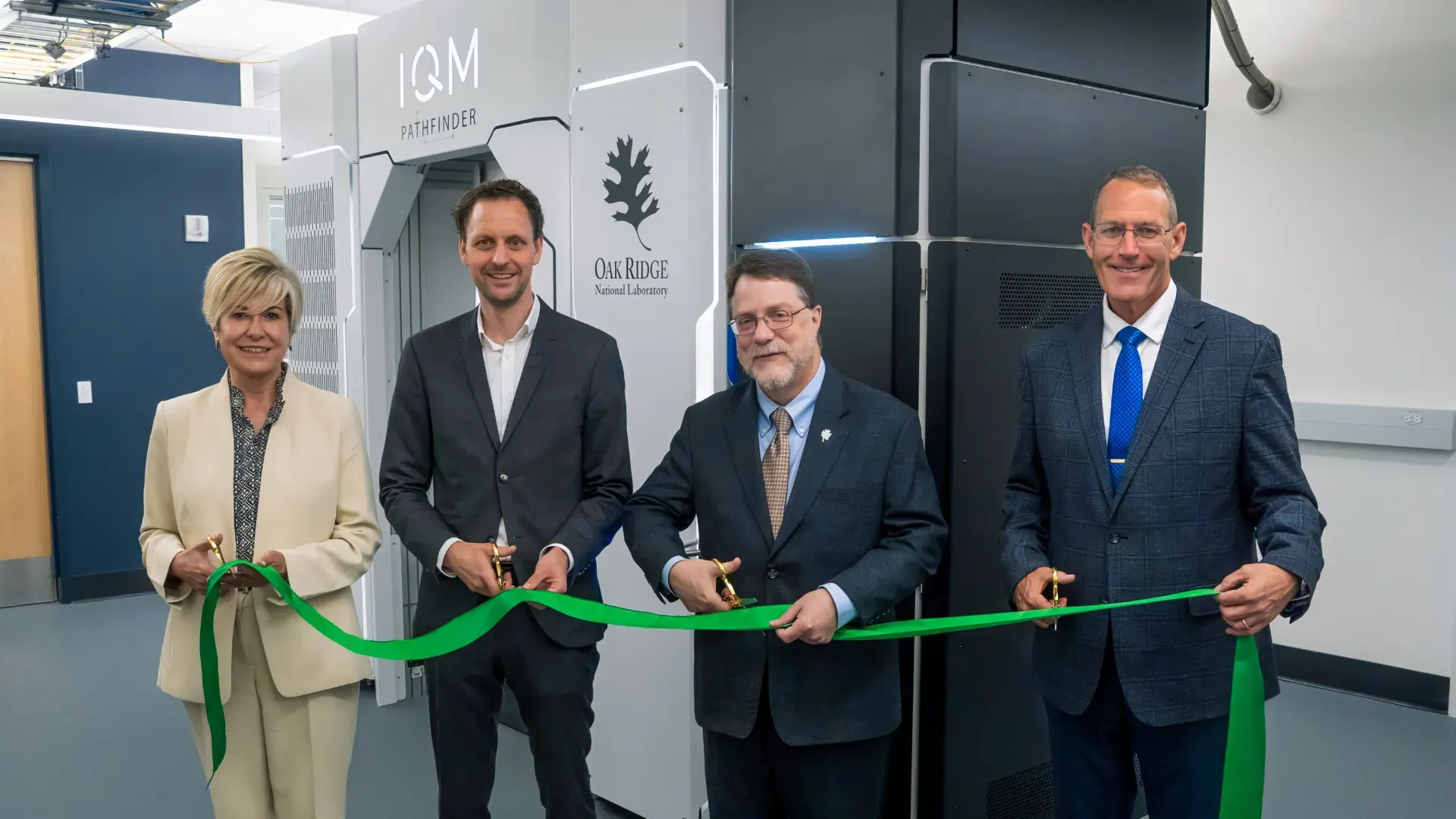
The U.S. Department of Energy’s Oak Ridge National Laboratory (ORNL) has officially launched Pathfinder, a 20‑qubit IQM Radiance full‑stack quantum computer. This marks two historic firsts: it is the first commercially procured quantum computer ever installed at ORNL, and it is IQM’s inaugural system on U.S. soil. Unlike many quantum offerings that are accessed remotely through cloud portals, Pathfinder resides on‑premises within ORNL’s campus and is directly wired into the laboratory’s flagship Frontier supercomputer environment. By embedding the quantum processor alongside one of the world’s most powerful open‑science HPC platforms, researchers can now experiment with truly hybrid quantum‑high‑performance‑computing (HPC) workloads, accelerating the development of algorithms that span both classical and quantum domains. The deployment also signals a broader shift toward on‑site quantum infrastructure in national labs, where control over hardware, data, and intellectual property (IP) is deemed essential for security‑sensitive research.
Pathfinder Deployment Details
Pathfinder is a 20‑qubit IQM Radiance system built by IQM Quantum Computers, a Finnish‑origin company that specializes in superconducting, full‑stack quantum machines. The system is owned and operated by ORNL, meaning the laboratory’s own technical teams are responsible for day‑to‑day maintenance, calibration, and software integration. This on‑premises model is a cornerstone of IQM’s commercial strategy: customers receive direct ownership of the hardware and retain full control over any IP generated on the device, rather than licensing access through a third‑party cloud service.
The quantum computer has been installed in the National Center for Computational Sciences (NCCS) Technology Integration Group’s test bed, a dedicated environment where emerging computing technologies are evaluated alongside existing HPC assets. Within this test bed, Pathfinder is physically linked to the Frontier supercomputer and other high‑performance resources, enabling low‑latency data exchange and coordinated job scheduling. Researchers can therefore launch hybrid jobs that, for example, perform a classical molecular dynamics simulation on Frontier, hand off a sub‑problem to the quantum processor for a variational quantum eigensolver calculation, and then recombine the results for further classical post‑processing—all without leaving the secure ORNL network.
IQM’s deployment record underscores the significance of this installation. To date, the company has sold 23 full‑stack quantum systems worldwide, more on‑premises installations than any other vendor in the market. These deployments span Europe, Asia, and North America, and include a mix of national laboratories, university research centers, and large‑scale HPC facilities. The Pathfinder system therefore adds to the largest on‑site quantum fleet globally and positions ORNL as a key node in IQM’s expanding ecosystem.
Strategic Fit Within ORNL’s HPC Ecosystem
ORNL is home to Frontier, currently the world’s most powerful open‑science supercomputer, and a hub for some of the most consequential high‑performance computing (HPC) research in the United States. Integrating Pathfinder into this environment aligns with the laboratory’s long‑term vision of building a scalable, hybrid quantum‑HPC ecosystem. As ORNL Quantum Science Center Director Travis Humble explained, “The presence of the IQM Radiance quantum computer on campus has already accelerated integration with our world‑class HPC capabilities. Our research teams are now developing new methods and tools to demonstrate applications in materials simulations, chemistry, and artificial intelligence.”
These efforts are already bearing fruit. Early‑stage collaborations are exploring quantum‑enhanced materials simulations, where the quantum processor tackles electronic structure problems that are intractable for classical methods alone. In computational chemistry, hybrid workflows aim to reduce the number of required quantum circuit evaluations, thereby shortening time‑to‑solution for reaction pathway analyses. Meanwhile, artificial intelligence teams are probing quantum‑inspired machine‑learning models that could benefit from the probabilistic nature of quantum states. By situating Pathfinder within the NCCS test bed, ORNL can iterate rapidly, moving from proof‑of‑concept code to production‑ready pipelines under the same security and compliance framework that governs all of its scientific computing.
IQM CEO and Co‑founder Jan Goetz highlighted the strategic importance of the location: “Quantum becomes useful when it works inside real computing infrastructure, and there is no better place to prove that. Oak Ridge is a place where serious computing is done.” The on‑premises approach also dovetails with ORNL’s broader policy of maintaining direct control over emerging technologies, reducing reliance on external cloud providers that may introduce latency, data‑sovereignty concerns, or additional regulatory hurdles.
Commercial and Market Context
The Pathfinder launch expands IQM’s commercial footprint in the United States at a pivotal moment for the company. IQM is preparing for a Nasdaq Global Select Market listing through a business combination with Real Asset Acquisition Corp. (Nasdaq: RAAQ), a transaction expected to close in mid‑2026. The visibility generated by a high‑profile deployment at a premier national laboratory bolsters investor confidence and showcases a tangible use case for IQM’s technology in a mission‑critical environment.
In parallel with the ORNL installation, IQM has opened its first U.S. Quantum Technology Center in Maryland’s Discovery District. This center is designed to foster quantum education, research collaborations, and partnerships with HPC service providers. By establishing a physical presence on the East Coast, IQM taps into the region’s deep talent pipeline and positions itself to support a growing community of U.S. researchers who require on‑site quantum hardware.
Political leaders have also weighed in on the partnership’s broader significance. Senators Marsha Blackburn (R‑TN) and Bill Hagerty (R‑TN) praised the collaboration as a catalyst for national security, economic competitiveness, and Tennessee’s leadership in quantum science, advanced energy systems, and manufacturing. Blackburn noted that the deployment “will empower Tennessee to strengthen America’s leadership in quantum science and other emerging technologies,” while Hagerty framed the project as “a tremendous technological investment” that underscores the state’s role as a global leader in quantum innovation.
Overall, the Pathfinder system serves as a proof point for the viability of on‑premises quantum computing in large‑scale scientific research, while simultaneously advancing IQM’s market positioning ahead of its public listing.
Key Takeaways
- Pathfinder is a 20‑qubit IQM Radiance system, the first commercially procured quantum computer at ORNL and IQM’s first U.S. installation.
- The system is owned and operated on‑premises by ORNL and is directly connected to the Frontier supercomputer and other HPC resources in the National Center for Computational Sciences test bed.
- IQM plans to list on the Nasdaq Global Select Market via a merger with Real Asset Acquisition Corp., targeted for mid‑2026, and has sold 23 full‑stack quantum systems globally, the most on‑premises installations of any vendor.
TechInsyte's Take
The on‑site integration of a quantum processor with a leading HPC platform provides a concrete testbed for hybrid workloads, a step that could inform future enterprise architectures. While the deployment demonstrates feasibility, the practical impact on production workloads remains to be measured, and buyers should monitor IQM’s performance data and the timeline for its public listing.
Source: Businesswire