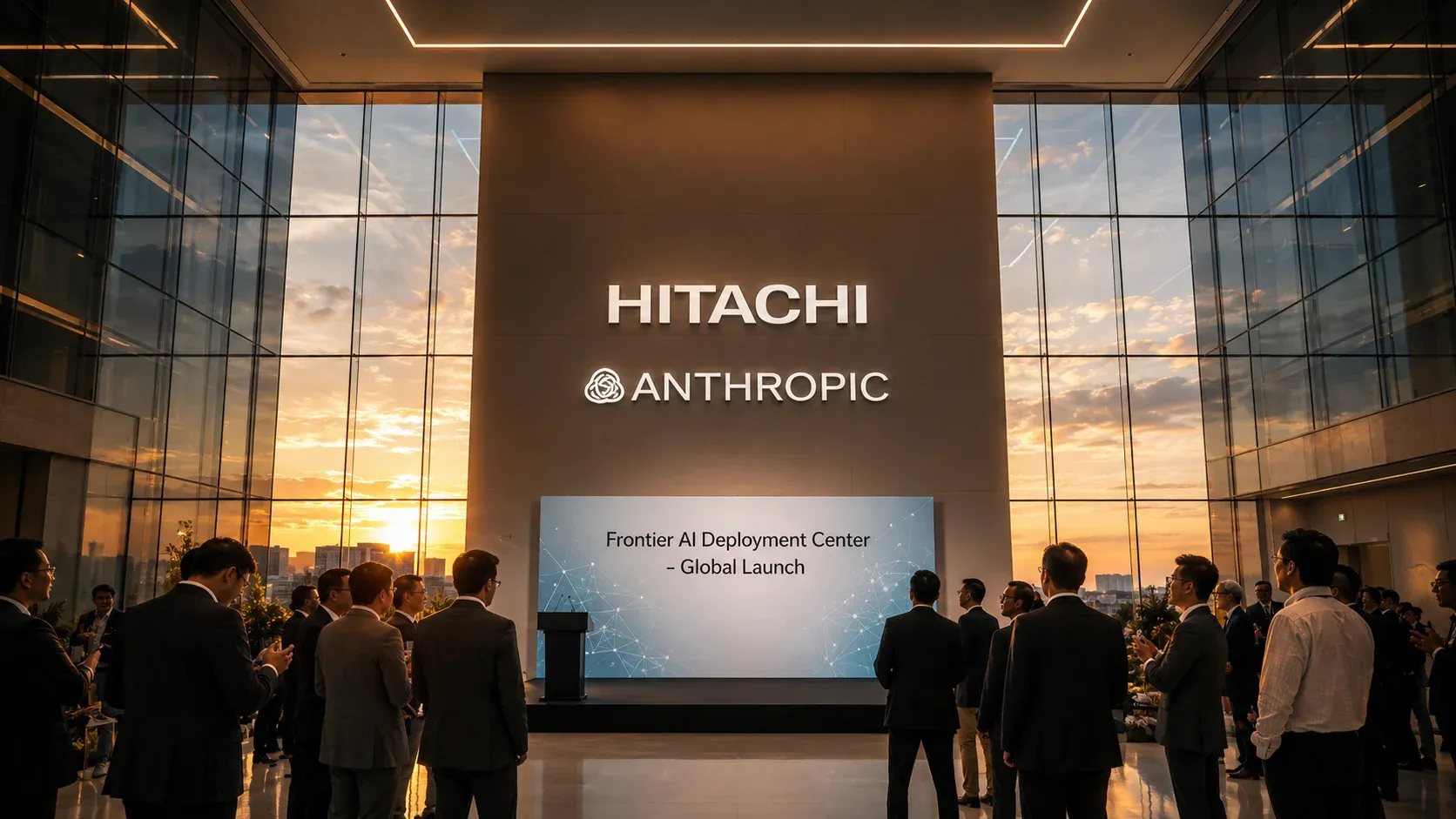
Hitachi announced a strategic partnership with Anthropic PBC to embed Anthropic’s Claude models into its “Lumada 3.0” platform and internal operations. The collaboration targets safe, large‑scale deployment of “physical AI” across critical infrastructure sectors—energy, transportation, manufacturing, and finance—and aims to transform Hitachi’s own workforce of roughly 290,000 employees. A new Frontier AI Deployment Center will coordinate the effort globally, beginning with a 100‑person team.
What Happened
Hitachi Ltd. (TSE:6501) and Anthropic PBC entered a partnership that combines Hitachi’s 110‑year legacy in IT, OT, and product engineering with Anthropic’s frontier‑AI research and Claude models, which the companies cite for safety and enterprise‑grade reliability. The alliance will:
- Accelerate system‑engineering, operations, and cybersecurity capabilities for critical‑infrastructure customers.
- Deploy Claude across Hitachi’s internal processes to improve productivity for its 290,000 employees.
- Launch joint talent programs to develop roughly 100,000 AI‑skilled professionals.
- Create the Frontier AI Deployment Center, a global hub in North America, Europe, and Asia, initially staffed by 100 experts and slated to grow to about 300.
Hitachi frames the internal rollout as a “Customer Zero” experiment, feeding lessons back into its HMAX solution suite—an extension of the Lumada 3.0 business model that delivers AI‑enhanced equipment management, maintenance optimization, and natural‑language interfaces for frontline workers.
Platform Context
Lumada 3.0 integrates data from Hitachi’s worldwide IT, OT, and product assets with domain expertise to address societal challenges. The partnership deepens this model by adding Claude’s advanced code generation, analysis, and high‑level reasoning capabilities. Key integration points highlighted include:
- System Development: Faster, higher‑quality software engineering through AI‑assisted coding.
- Cybersecurity: Joint work between Hitachi’s Cyber Center of Excellence and Anthropic to improve threat detection and response for finance, transportation, and power‑grid customers.
- HMAX Enhancements: Natural‑language equipment management and algorithmic maintenance scheduling to reduce downtime and cost.
The Frontier AI Deployment Center will serve as the coordination layer for co‑creating physical‑AI use cases, deploying them in real environments, and scaling next‑generation solutions.
Buyer Impact
Enterprises in the targeted sectors can expect several concrete benefits:
- Improved Operational Efficiency: AI‑driven code generation and analytics aim to cut development effort and streamline corporate functions such as sales and planning.
- Enhanced Resilience: Integrated cybersecurity capabilities are intended to harden critical‑infrastructure systems against emerging threats.
- Frontline Support: Natural‑language interfaces and predictive maintenance tools could reduce equipment downtime and alleviate labor shortages in manufacturing and infrastructure operations.
Hitachi’s “Customer Zero” rollout will generate best‑practice templates that participating customers may adopt, potentially shortening time‑to‑value for AI projects. However, the announcement does not provide specific ROI metrics or deployment timelines beyond the initial 100‑person Center team.
What To Watch
- Scale of Internal Adoption: Hitachi plans to become one of the world’s largest enterprise users of Claude. Monitoring how quickly the 290,000‑employee rollout progresses will indicate the practicality of large‑scale AI integration.
- Talent Development Outcomes: The goal of training 100,000 AI professionals is ambitious; progress reports will reveal whether the skill pipeline can meet internal and customer‑facing needs.
- Regulatory and Safety Validation: Physical AI in mission‑critical environments will be subject to sector‑specific compliance checks. How Hitachi and Anthropic address safety certifications could affect broader industry adoption.
- Customer Pilots: Early case studies from the Frontier AI Deployment Center will illustrate real‑world performance, especially in cybersecurity and equipment‑management use cases.
Key Takeaways
- Hitachi and Anthropic will embed Claude models into Hitachi’s Lumada 3.0 platform and internal workflows, targeting safe deployment of physical AI.
- The partnership includes a global Frontier AI Deployment Center, starting with 100 experts and planned expansion to about 300.
- Hitachi aims to train roughly 100,000 AI professionals and use its internal “Customer Zero” experience to refine HMAX solutions for critical‑infrastructure customers.
TechInsyte's Take
For CIOs and CTOs overseeing critical‑infrastructure portfolios, the Hitachi‑Anthropic alliance signals a concrete step toward enterprise‑grade physical AI that prioritizes safety and cybersecurity. The joint effort could reduce development cycles and operational downtime, but the true test will be how quickly Hitachi can translate its internal rollout into repeatable, compliant solutions for customers. Decision‑makers should watch the first deployments from the Frontier AI Deployment Center for measurable performance gains and watch for any regulatory hurdles that may arise as AI moves from data‑center to plant‑floor. The scale of talent development also warrants attention; a well‑trained AI workforce will be essential to sustain the promised productivity gains. Until detailed pilot results emerge, the partnership remains a promising but still‑proving pathway for AI‑enabled infrastructure modernization.
Source: Businesswire