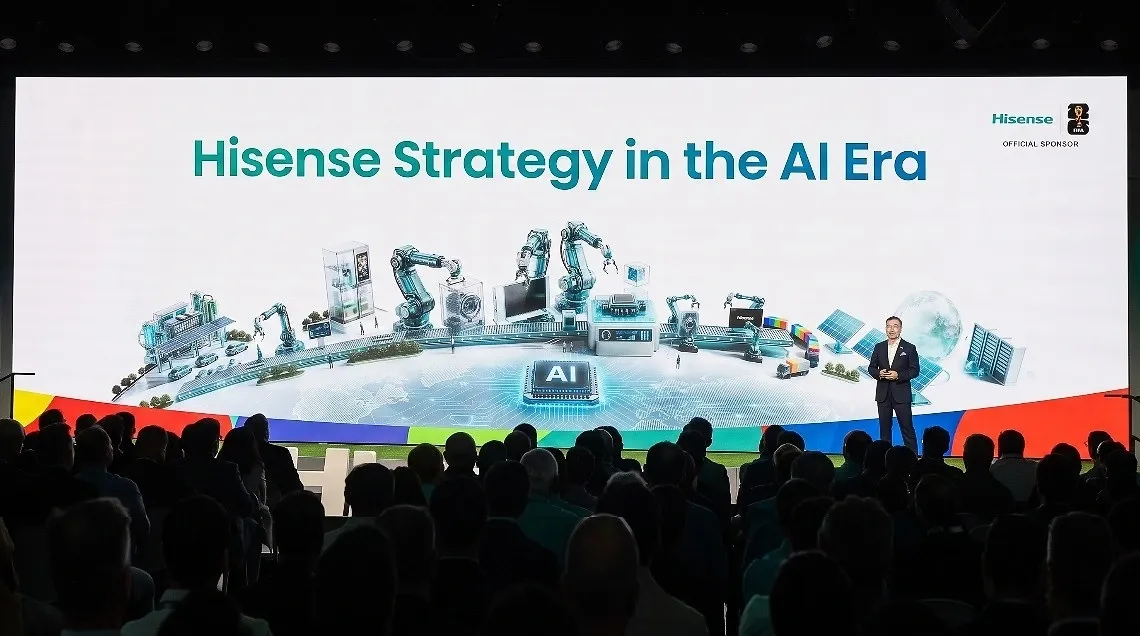
Hisense has announced a comprehensive AI-powered growth strategy designed to guide its next phase of global development and reinforce its commitment to intelligent living. Introduced at the Hisense Global Partner Conference 2026 in New York, the roadmap focuses on integrating artificial intelligence across the company's entire value chain. This strategic shift aims to transition the brand from a manufacturer of smart devices into a provider of proactive smart home companions, leveraging advanced AI ecosystems to drive long-term value for global customers and enterprise partners.
The Five Pillars of Hisense AI Strategy
CEO Fisher Yu outlined a strategic framework built upon five specific pillars to navigate the evolving AI era. First, the company intends to expand its AI footprint across the core AI value chain. Second, Hisense plans to transform existing smart devices into proactive smart home companions through AI-driven scenario innovation. The third pillar involves maintaining a long-term sports marketing strategy to strengthen global brand presence. Fourth, the company will adhere to a service-first approach to enhance user experience. Finally, Hisense aims to deepen "glocalization" to create sustained value for partners. This multifaceted approach signals a move toward rebuilding the entire business architecture around artificial intelligence. By integrating these pillars, Hisense seeks to move beyond simple device functionality, positioning its hardware as an intelligent, responsive ecosystem that anticipates user needs and integrates seamlessly into the modern home environment through advanced connectivity and localized service models.
Technical Integration via V AI OS and ConnectLife
At the technical core of this strategy is an integrated AI ecosystem that spans semiconductors, smart energy, laser technology, and automotive electronics. Hisense is deploying specific software layers to realize its vision of "smart companions." For example, the V AI OS powers Hisense TVs, allowing them to analyze user intent and deliver highly personalized content recommendations. Simultaneously, the ConnectLife platform enables connected appliances to operate intelligently across four key domains: cooking, laundry, air management, and energy optimization. This unification allows devices to proactively perceive surroundings and communicate naturally. By advancing growth in the AI Hub and semiconductor sectors, Hisense is securing the underlying infrastructure necessary to support these high-level consumer applications. This technical evolution suggests a shift from reactive hardware to a predictive, unified ecosystem where intelligence is embedded directly into the hardware and software layers of the home.
Key Takeaways
- Hisense is implementing a five-pillar strategy focusing on AI value chains, smart companions, sports marketing, service-first approaches, and glocalization.
- The company is utilizing V AI OS for personalized TV content and the ConnectLife platform for intelligent appliance management in cooking, laundry, air, and energy.
- The strategic announcement was made at the Hisense Global Partner Conference 2026 in New York, ahead of the FIFA World Cup 2026 Final.
TechInsyte's Take
In our view, Hisense is attempting a high-stakes pivot from a hardware-centric manufacturer to an AI-integrated ecosystem provider. By targeting the entire value chain—including semiconductors and automotive electronics—the company is attempting to control the underlying intelligence that powers its consumer goods. This move suggests that Hisense recognizes that hardware margins alone may not sustain long-term growth in a saturated market. Instead, they are betting on the "companion" model, where software-driven personalization and proactive device interaction create higher switching costs and deeper user engagement. This strategy signals a broader industry trend where intelligence, rather than raw specifications, becomes the primary competitive differentiator.
Source: https://www.prnewswire.com/