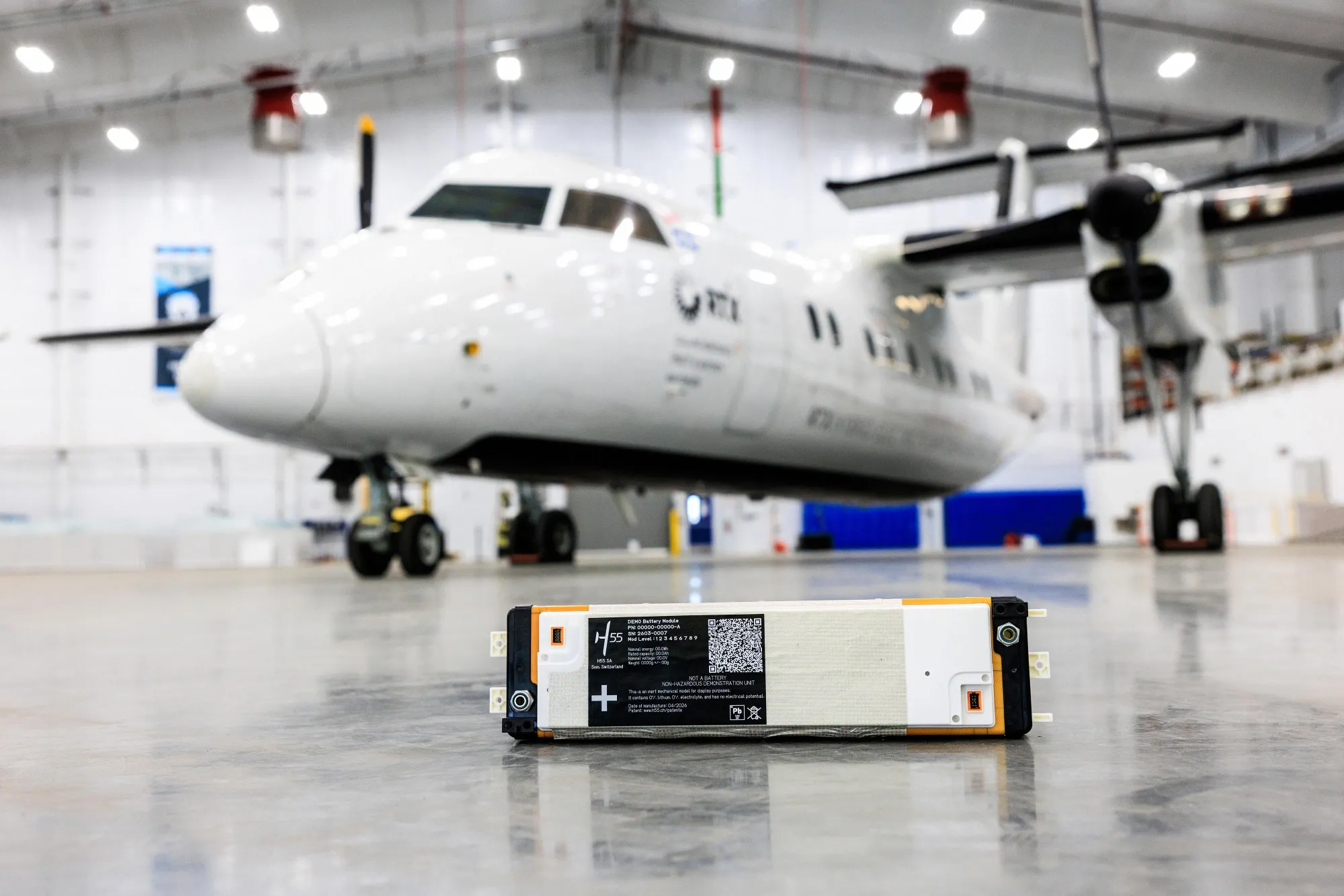
H55 has announced the delivery of certification-grade propulsion battery modules to Pratt & Whitney Canada to support the RTX Hybrid-Electric Flight Demonstrator. This milestone represents a significant shift for H55, marking the company's transition from initial technology development to industrial-scale execution and the commercialization of energy storage solutions for hybrid-electric aviation. By providing production-conforming systems, H55 is moving its certification-grade technologies into active aerospace applications, supporting the broader goal of demonstrating hybrid-electric aircraft technology in flight.
H55 Transition to Industrial-Scale Execution for RTX Demonstrator
The delivery of these production-conforming systems, which were manufactured in a regulator-approved facility, allows H55 to move directly into active aircraft integration and flight-test programs. According to the company, the ability to manufacture such systems within a regulator-approved environment is a specialized capability currently held by only a small number of companies globally. These modules are intended to support the RTX Hybrid-Electric Flight Demonstrator, where Pratt & Whitney, an RTX business, is testing hybrid-electric technology to potentially improve performance and fuel efficiency across a wide range of future aircraft platforms.
As the industry moves beyond early-stage concepts toward full commercialization, H55 notes that aircraft manufacturers now require partners who can provide more than just innovation. They require industrial maturity, scalable systems integration, and certification-ready production systems. H55 Co-Founder and CTO Sébastien Demont stated that delivering these modules validates the company's ability to meet requirements for operational reliability and industrialized manufacturing at an industrial scale.
H55 Battery Architecture and Certification Milestones
H55 developed its proprietary battery architecture specifically to address the demanding operational and certification requirements inherent to hybrid-electric propulsion systems. This focus on safety and regulatory compliance has allowed the company to become the first in the industry to complete regulator-required propulsion battery certification testing. This achievement now serves as the essential foundation for H55's deliveries into active aerospace programs.
To further strengthen its competitive position, H55 has accumulated an operational dataset consisting of more than 2,000 flight hours across multiple aircraft programs. Throughout these operations, the company has recorded zero battery-related incidents, providing a validated safety record to accompany its technical architecture.
Commercialization Path for Hybrid-Electric Aerospace Applications
The company is positioning this delivery as a foundation for expanding its certification-grade energy storage solutions into broader markets. By combining regulator-approved manufacturing, validated flight experience, and certification-grade safety architecture, H55 aims to deploy its scalable propulsion system integration across several sectors. These include next-generation aerospace platforms, unmanned aerial vehicles (UAVs), and various defense applications. This milestone reinforces H55's position as a primary supplier of energy storage solutions as hybrid-electric aviation advances toward widespread commercial deployment.
Key Takeaways
- H55 delivered production-conforming propulsion battery modules to Pratt & Whitney Canada for the RTX Hybrid-Electric Flight Demonstrator.
- H55 is the first company in the industry to complete regulator-required propulsion battery certification testing.
- The company has recorded over 2,000 flight hours across multiple aircraft programs without any battery-related incidents.
TechInsyte's Take
The transition from prototype development to regulator-approved manufacturing is a critical hurdle for aerospace energy storage. While H55 has established a safety record and completed initial certification testing, the primary focus for executives will be how these modules perform within the RTX flight demonstrator. Buyers should monitor whether this industrial-scale execution leads to broader adoption in the UAV and defense sectors.
Source: Businesswire