
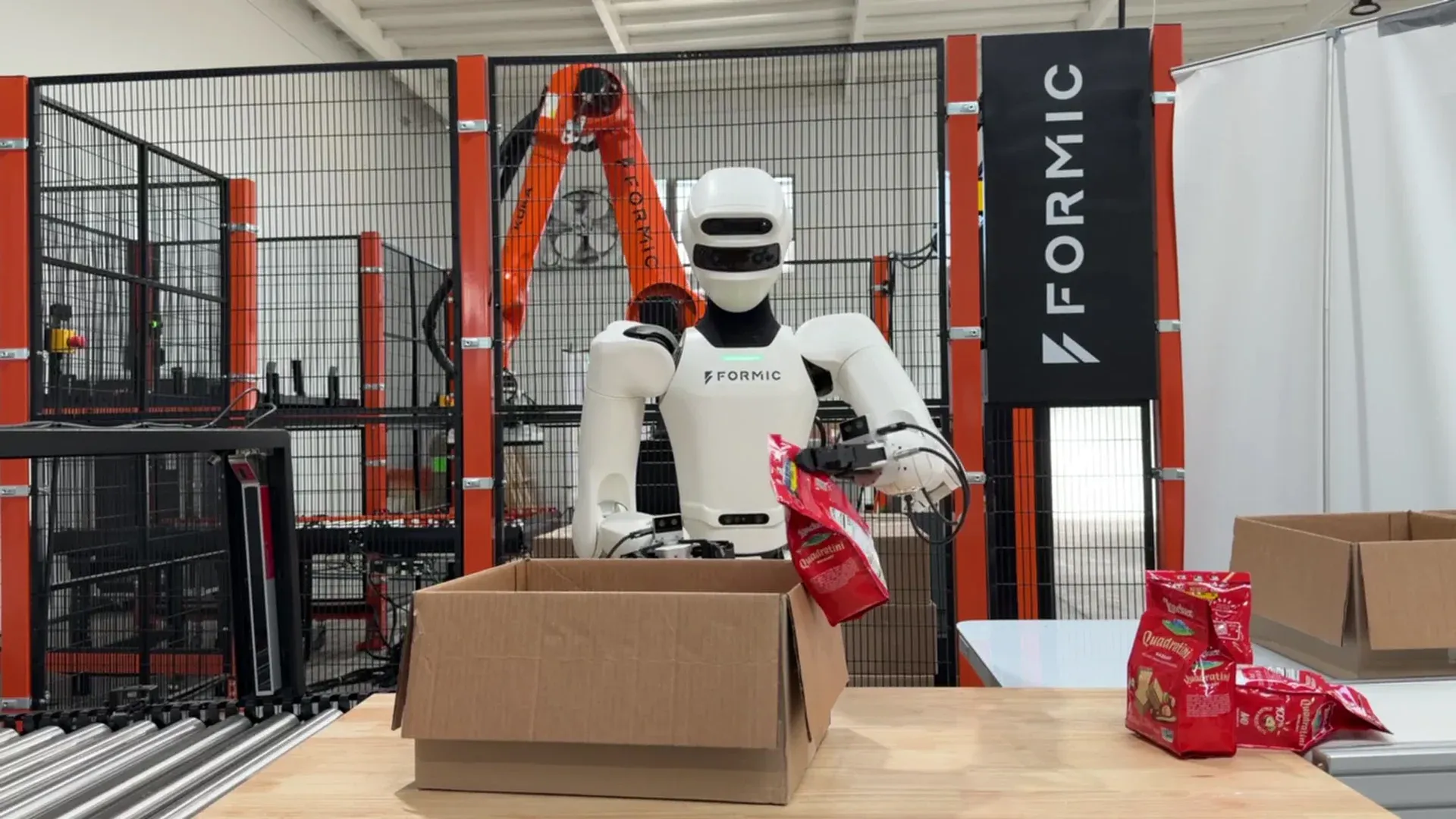
Formic is positioning itself to bridge the critical gap between laboratory-grade robotics and real-world industrial utility by transitioning from task-specific automation to general-purpose robotics. The Chicago-based company announced it has raised $50 million in growth capital, a Series B round led by Mercato Partners with participation from Light Ray Ventures, Lightscape Partners, Citi, and other investors, supplemented by debt financing from S2G Investments. This capital injection aims to accelerate the deployment of increasingly complex robotic systems across the American industrial base. By leveraging over 750,000 hours of live production data, Formic intends to move beyond single-function machines toward versatile systems capable of handling diverse manufacturing requirements without requiring customers to manage the underlying technical or financial complexities.
Formic $50M Series B and the Shift to General-Purpose Robotics
The $50 million financing marks a strategic pivot for Formic as it seeks to expand its footprint in the physical AI sector. While the company has historically focused on task-specific automation—handling discrete functions like palletizing, case packing, and machine tending—the new capital is earmarked for the development and deployment of general-purpose robotics. This shift suggests an attempt to move away from rigid, single-use hardware toward more adaptable systems that can perform a broader range of complex tasks across various industrial sectors.
To support this transition, Formic is expanding its technological reach into new applications, specifically targeting metal fabrication. The company also plans to deepen its presence in high-stakes industries, including aerospace, space, defense, medical, and energy. This expansion is supported by a dual-location infrastructure: a new assembly and testing facility in Bolingbrook, Illinois, and an R&D center in Oakland, California. By integrating robotic foundation models with its existing production data, Formic is working to adapt physical intelligence for broader manufacturing use cases. This approach aims to utilize the operational intelligence gathered from its current fleet of hundreds of robots across more than 100 facilities to train and refine the next generation of more capable, multi-functional robotic systems.
Scaling Physical AI via Robot-as-a-Service Models
Formic is attempting to solve the "loading dock" bottleneck—the difficulty of deploying, servicing, and financing robots in active production environments—through its Robot-as-a-Service (RaaS) model. Rather than requiring manufacturers to commit significant upfront capital, Formic provides equipment, deployment software, field operations, maintenance, and performance monitoring for a single recurring monthly payment. This model shifts the responsibility for uptime and productivity from the manufacturer to Formic, which currently reports a 99.6% uptime rate across its fleet.
The company’s strategy relies heavily on the data loop created by its existing deployments in over 30 states. Every robot in the fleet generates data regarding operating conditions, task performance, and necessary corrective actions. Formic is using this feedback to inform future deployments and robot improvements, a process it claims allows it to deploy robots into production approximately three times faster than it did one year ago. By combining financing with operational expertise, Formic is positioning its platform as a way for domestic manufacturers to increase capacity and reliability without the traditional financial risks associated with large-scale automation investments.
Key Takeaways
- Formic raised $50 million in a Series B round led by Mercato Partners to accelerate its expansion into general-purpose robotics.
- The company currently operates hundreds of robots across more than 100 facilities in over 30 states, maintaining a 99.6% uptime rate.
- Formic utilizes a Robot-as-a-Service model that includes equipment, software, maintenance, and financing for a single monthly fee.
TechInsyte's Take
In our view, Formic’s move toward general-purpose robotics is a calculated attempt to solve the scalability problem that has long plagued industrial automation. Most robotics companies focus on the "brain" (the AI) or the "body" (the hardware), but Formic is betting that the real enterprise value lies in the "nervous system"—the operational and financial infrastructure required to keep machines running in messy, unpredictable factory environments. By transitioning from task-specific tools to general-purpose systems, Formic is attempting to move from being a vendor of specialized equipment to a fundamental layer of industrial infrastructure. If they can successfully leverage their 750,000 hours of production data to train more versatile models, they may create a significant moat. The success of this strategy depends entirely on whether their RaaS model can maintain high uptime while managing the increased complexity of more versatile, non-specialized robotic hardware.
Questions & Answers
How does Formic's financing model impact manufacturer capital expenditure?
Formic utilizes a Robot-as-a-Service (RaaS) model, which allows manufacturers to implement automation through a single recurring monthly payment. This approach eliminates the need for significant upfront capital investment, enabling companies to increase production capacity without heavily impacting their balance sheets.
What is the strategic goal of the new $50 million funding round?
The funding is intended to accelerate Formic's transition from task-specific automation to general-purpose robotics. This includes expanding into new applications like metal fabrication and deepening its presence in sectors such as aerospace, defense, medical, and energy.
How does Formic utilize its existing fleet to improve future robotic capabilities?
Formic uses the data generated by its current fleet—which has accumulated over 750,000 hours of live production—to gather intelligence on tasks, operating conditions, and corrective actions. This data is used to inform robot improvements and train the next generation of more capable, general-purpose robotic systems.
What operational metrics does Formic currently report for its robotic deployments?
Formic reports that its fleet operates across more than 100 facilities in over 30 states, maintaining a 99.6% uptime rate. Additionally, the company notes a 97% customer renewal rate and a deployment speed that is approximately three times faster than the previous year.
Source: Formic