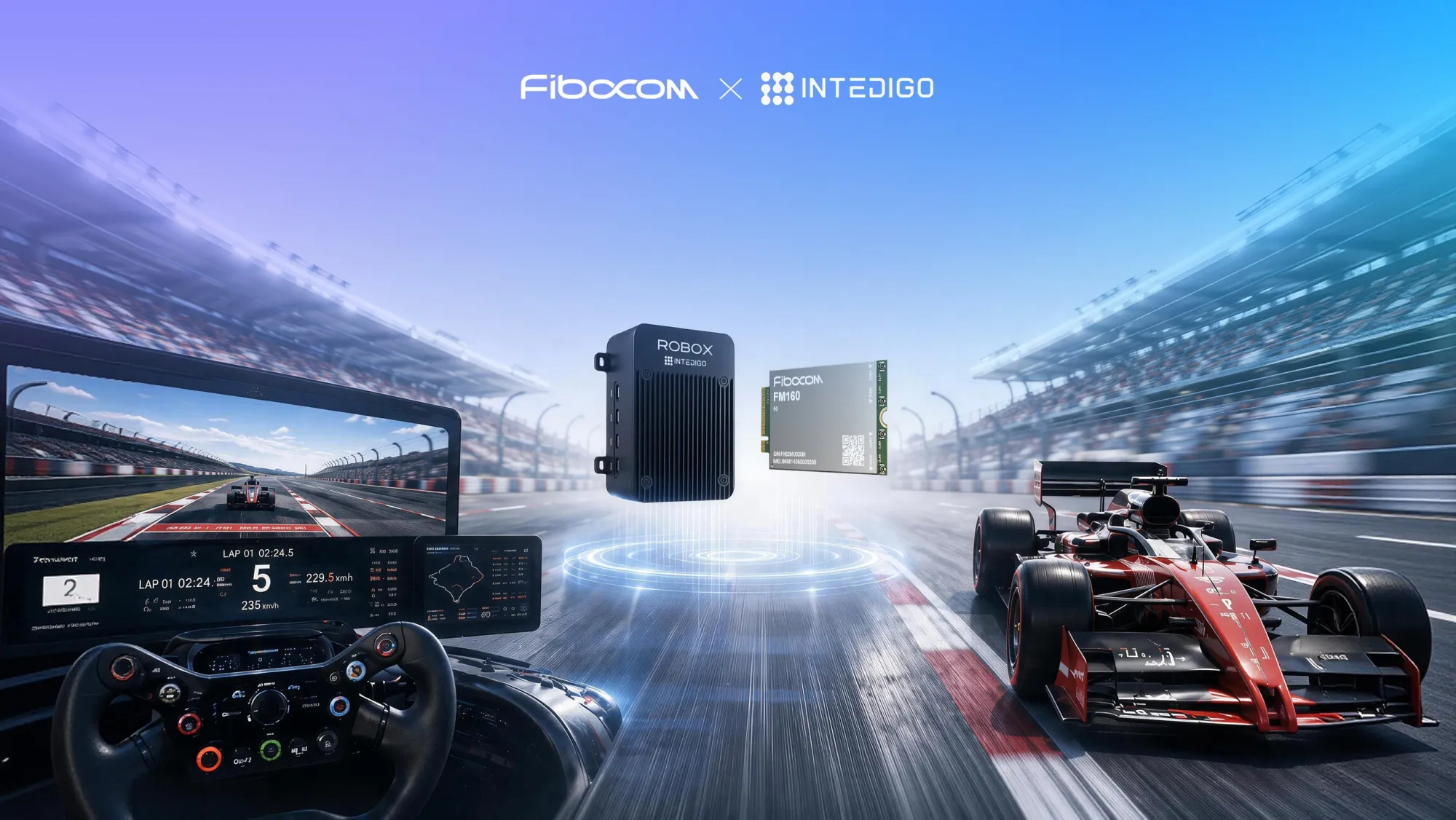
Fibocom and Intedigo have announced a joint beyond-visual-line-of-sight (BVLOS) teleoperation demonstration scheduled for the World Artificial Intelligence Conference (WAIC) 2026. From July 17 to 20, the companies will showcase a cross-regional system where a remote cockpit controls a real race car located at HURA PARK in Jiading, Shanghai. This demonstration serves as a live validation of 5G bidirectional data transmission, specifically designed to support embodied AI teleoperation. By enabling real-time steering, acceleration, and braking, the collaboration highlights the critical role of low-latency connectivity in managing high-dynamic maneuvers and complex machine-to-human interactions.
Intedigo and Fibocom 5G Teleoperation Demonstration
The demonstration utilizes Intedigo’s remote driving system to connect an immersive cockpit with a physical race car, creating a closed-loop teleoperation environment. To ensure operational safety during high-speed cornering and precision braking, the system supports 1080p@60Hz video transmission with glass-to-glass (G2G) video latency of less than 80 ms. Furthermore, control latency is maintained at less than 10 ms. Fibocom provides the underlying cellular connectivity through its FM160 5G module, which is powered by the Qualcomm Snapdragon X62 5G Modem-RF System. This module supports both SA and NSA network architectures and 3GPP Release 16. On the downlink, the FM160 supports NR Carrier Aggregation with up to 120 MHz bandwidth, achieving peak speeds of 3.5 Gbps in NSA mode and 2.5 Gbps in SA mode. On the uplink, it delivers peak speeds of up to 900 Mbps in SA mode, ensuring continuous HD video and vehicle status data transmission.
Enabling Human-in-the-Loop for Embodied AI
As embodied AI integrates into factories, data centers, and logistics operations, the need for Human-in-the-Loop (HITL) remote intervention becomes vital for managing edge cases and unexpected environmental complexities. While robots increasingly perform autonomous tasks, reliable connectivity remains the foundation for telemetry feedback and remote operational management. Intedigo CEO Daniel Liu notes that while remote racing serves as an accessible entry point, the true objective is validating communication systems for remote collaboration between humans and robots. The demonstration aims to prove that 5G can transition from connecting people to connecting machines, such as robots and unmanned equipment. By providing a verifiable framework for bidirectional data, the partnership seeks to enable more intelligent terminals to receive remote assistance, ensuring they remain continuously connected and operate reliably within real-world industrial applications and complex, high-stakes environments.
Key Takeaways
- The Intedigo remote driving system achieves glass-to-glass video latency of less than 80 ms and control latency of less than 10 ms.
- Fibocom’s FM160 5G module supports peak downlink speeds of up to 3.5 Gbps in NSA mode and 900 Mbps uplink speeds in SA mode.
- The demonstration at WAIC 2026 will feature a real race car at HURA PARK in Jiading, Shanghai, controlled via a remote cockpit.
TechInsyte's Take
In our view, this collaboration signals a critical shift in the utility of 5G infrastructure from consumer-centric mobile broadband to industrial-grade machine communication. By focusing on the stringent latency requirements of high-speed racing, Fibocom and Intedigo are effectively stress-testing the "Human-in-the-Loop" model required for the next phase of embodied AI. For enterprise decision-makers, this suggests that the viability of autonomous robotics in unpredictable environments—such as logistics or manufacturing—is increasingly dependent on the deterministic performance of 5G modules like the FM160. This move validates that low-latency, bidirectional data is no longer a luxury but a functional requirement for scaling intelligent, remote-assisted machine fleets.
Source: https://www.prnewswire.com/