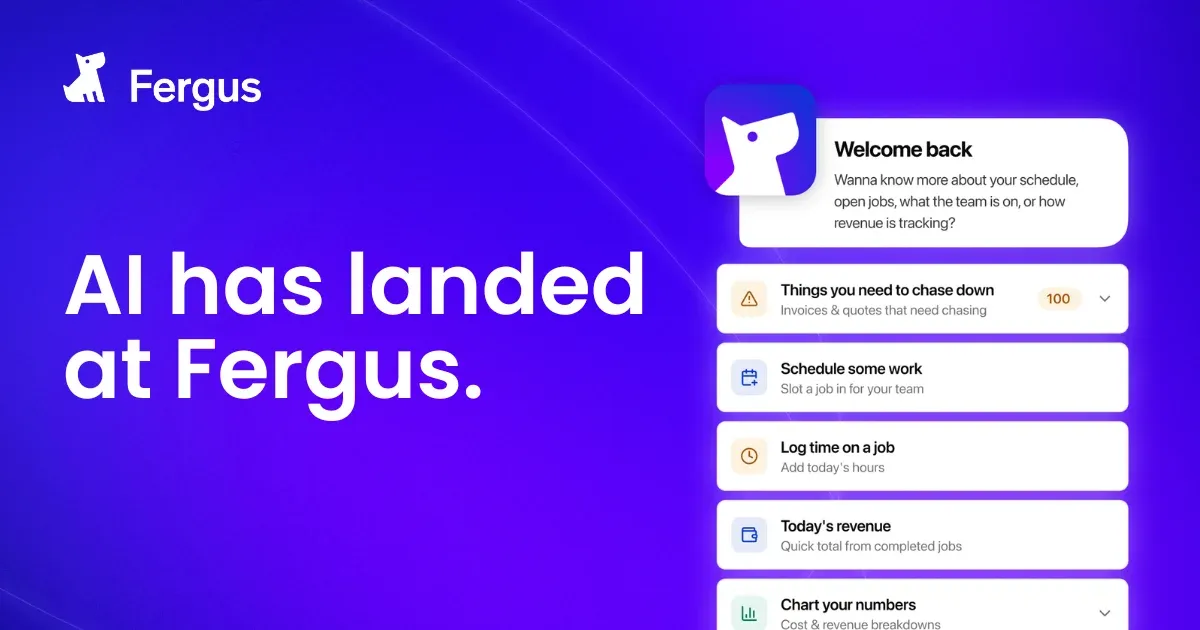
The integration of generative AI into specialized vertical SaaS marks a shift from passive data recording to active operational assistance in the skilled trades sector. Fergus, a job management platform serving over 26,000 tradespeople across Australia, New Zealand, and the United Kingdom, has launched an AI-first approach designed to automate administrative workflows. By embedding intelligence directly into existing job management systems, the company aims to address the persistent "paperwork gap" that remains even after the transition from manual to digital record-keeping. This strategic move positions Fergus to move beyond simple coordination, attempting to automate the lifecycle of a job from initial inquiry to final payment through contextual data utilization.
Fergus Assistant and AI-First Workflow Integration
Fergus is deploying its AI capabilities through two primary interfaces to ensure coverage across different work environments. The first, Fergus Assistant, is integrated into the existing web-based product used by office teams and business owners to manage scheduling, quotes, and reporting. The second interface, Fergus Assistant on mobile, targets field workers by allowing them to use voice or text inputs on-site to capture job details. This mobile functionality is intended to prevent the need for manual data recreation in an office setting by feeding site updates directly into quotes or invoices.
The company is also introducing a broader "Fergus AI" experience, which is scheduled to roll out across its three primary markets next week. This layer is designed to function alongside business operators, handling administrative tasks throughout the entire job lifecycle. Unlike general-purpose AI tools that require manual data entry or complex prompting, Fergus is leveraging 15 years of proprietary trade data and existing job context—including customer details, site specifics, and cost structures—to execute tasks. This approach aims to reduce the "clicks and paperwork" typically associated with managing trade-based service businesses.
Leveraging Contextual Data for Financial Intelligence
The technical differentiation of the Fergus rollout lies in the platform's ability to perform complex financial queries using grounded, existing data. Because the system already houses historical and real-time information regarding costs, quotes, and invoices, it can provide immediate answers to specific business intelligence questions. For example, business owners can query the system to identify why a specific job is losing money or to determine which jobs generated the highest margins in the previous month.
This capability shifts the software's role from a mere repository of information to a tool for decision support. The platform can also generate custom reports based on natural language descriptions, building them in seconds rather than requiring manual configuration. By combining AI with deep domain knowledge of trade workflows, Fergus is attempting to solve the problem of "lost time" in administration. The company's stated goal is to allow tradespeople to spend less time operating software and more time managing profitable operations, effectively using AI to protect margins and accelerate the conversion of completed work into cash flow.
Key Takeaways
- Fergus is deploying AI capabilities to over 26,000 tradespeople across Australia, New Zealand, and the United Kingdom.
- The rollout includes Fergus Assistant for web and mobile, with a full Fergus AI experience launching across all markets next week.
- The platform utilizes existing job, cost, and invoice data to allow users to generate reports and perform financial analysis via natural language queries.
TechInsyte's Take
In our view, Fergus is executing a textbook "vertical AI" strategy by avoiding the trap of building a standalone tool that requires new user habits. By embedding AI into the existing mobile and web workflows, they are addressing the primary friction point in trade services: the disconnect between site activity and office administration. This is not merely a feature update; it is a pivot toward becoming an autonomous operational layer. The ability to ask "Why is this job losing money?" suggests that Fergus is moving toward predictive and diagnostic utility, which is far more valuable to a business owner than simple automation. If successful, this model demonstrates how specialized SaaS providers can defend their market position by turning their accumulated proprietary data into a functional, intelligent agent that actively manages business health rather than just recording it.
Questions & Answers
How does Fergus differentiate its AI from general-purpose LLMs?
Fergus differentiates its AI by grounding it in 15 years of specific trade data and existing job context. Unlike general AI, it does not require separate system integration or specialized prompting expertise because it already possesses the customer, site, cost, and invoice data necessary to perform tasks and answer complex financial questions.
What specific administrative tasks can the mobile AI interface handle?
The Fergus Assistant on mobile allows tradespeople to use voice or text to capture site activity in real-time. This information can then flow directly into quotes or invoices, intended to eliminate the need for workers to recreate or manually enter data once they return to an office environment.
What is the timeline for the full Fergus AI rollout?
While Fergus Assistant and Fergus Go are currently available to customers, the broader Fergus AI experience is scheduled to roll out across Australia, New Zealand, and the United Kingdom starting next week.
How can business owners use the AI for financial decision-making?
Owners can use the AI to perform rapid financial analysis by asking natural language questions, such as identifying unprofitable jobs or determining which jobs yielded the most profit in a specific period. The system can also build custom reports in seconds based on user descriptions.
Source: GlobeNewswire