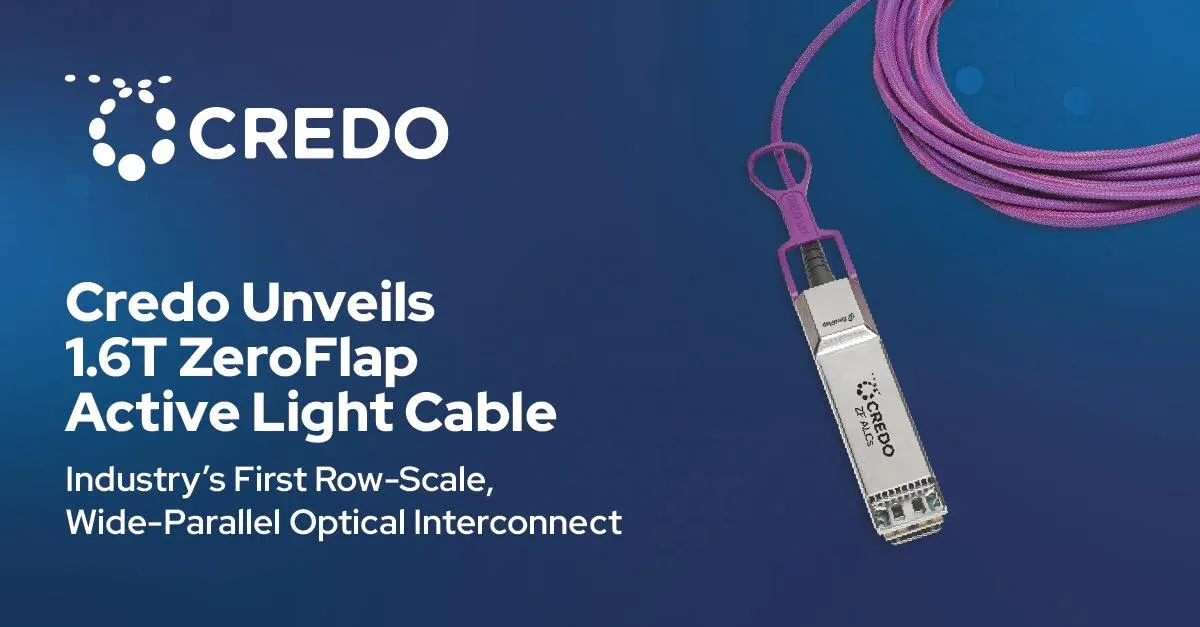
Credo Technology Group Holding Ltd is attempting to bridge a critical connectivity void in AI infrastructure by shifting the fundamental architecture of optical interconnects. As AI clusters expand across data center rows, the industry faces a widening gap between the distance limitations of copper cables and the high power, high cost requirements of traditional pluggable optics. To address this, Credo has introduced its 1.6T ZeroFlap active light cable (ALC), a wide-parallel optical solution designed for scale-out and front-end networks. By moving away from high-speed single channels toward a "slow-and-wide" micro-emitter approach, the company aims to provide row-scale reach of up to 50m while maintaining the reliability and energy efficiency typically associated with copper-based connections.
Addressing the Mid-Reach Connectivity Gap
The introduction of the 1.6T ZeroFlap ALC signals a strategic pivot in how data centers manage high-density AI workloads. Currently, operators must choose between copper cables, which lack the necessary reach for growing clusters, and traditional pluggable optics, which often demand excessive power and capital expenditure. Credo is positioning this new ALC solution to occupy the mid-reach segment, targeting distances up to 50m. This capability is intended to support the massive-scale AI deployments that require connectivity across entire data center rows.
Technically, the ZeroFlap ALC utilizes a dense array of micro-emitters and photodetectors coupled with flexible, lightweight fiber bundles. Instead of pushing a limited number of optical channels to extreme data rates, the architecture splits 200G lanes into numerous low-rate optical channels using simple NRZ modulation. This design choice is intended to bypass the power and latency penalties associated with complex DSP-based signal processing. By utilizing many micro-emitters operating in parallel at optimal individual speeds, Credo suggests the technology can achieve lower power per bit. The company expects to begin shipping these 1.6T ALC solutions in 2027, providing a potential alternative for front-end network scaling.
Engineering Reliability for AI Scale-Out
A primary driver behind the ZeroFlap architecture is the demand for "copper-class" reliability within optical frameworks. As L.K. Bhupathi, Associate Vice President of Product at Credo, noted, traditional optical transceivers have historically prioritized data rate per fiber, whereas the ZeroFlap ALC is engineered with reliability as a primary concern. To support the dense connections found in AI clusters, the company is incorporating built-in channel redundancy and ZeroFlap link monitoring. These features are intended to enable hitless failover, aiming for a target reliability of 100 million hours mean time between failures (MTBF) and bit error rates that outperform traditional optics.
From an operational efficiency standpoint, the ZeroFlap ALC is designed to draw 12W per cable-end. Credo claims this represents roughly 30% less power consumption than comparable active electrical cables (AECs). Furthermore, the solution is described as being 10x lighter than AECs, which could assist in managing cable bulk within high-density racks. By combining these efficiency gains with extended reach, Credo is testing whether a parallelized optical approach can meet the rigorous uptime and thermal requirements of next-generation GPU clusters and large-scale AI infrastructure.
Key Takeaways
- Credo's 1.6T ZeroFlap ALC targets a reach of up to 50m to bridge the gap between copper and traditional pluggable optics.
- The architecture utilizes a "slow-and-wide" approach, splitting 200G lanes into low-rate channels using NRZ modulation to reduce power and latency.
- The solution is designed to draw 12W per cable-end and targets a mean time between failures (MTBF) of 100 million hours.
TechInsyte's Take
In our view, Credo’s move toward a "slow-and-wide" optical architecture is a pragmatic response to the physical limitations of current AI scaling models. As GPU clusters grow, the industry is hitting a wall where traditional high-speed serial optics become too power-hungry and copper becomes too short. By leveraging micro-emitter arrays and NRZ modulation, Credo is essentially attempting to commoditize the optical layer by making it behave more like the simpler, more reliable electrical links that data center operators already trust. If the 1.6T ZeroFlap ALC can deliver on its 100-million-hour MTBF claim and the promised 30% power reduction compared to AECs, it could become a vital component in the transition from rack-level to row-level AI connectivity. However, the 2027 shipping timeline means this is a long-term play for the evolving data center landscape.
Questions & Answers
How does the ZeroFlap ALC architecture differ from traditional optical transceivers?
Traditional transceivers typically prioritize maximizing the data rate per individual fiber. In contrast, the ZeroFlap ALC uses a wide-parallel approach, employing a dense array of micro-emitters to split 200G lanes into many low-rate optical channels using simple NRZ modulation, which avoids the power and latency costs of complex DSP-based processing.
What specific power and weight advantages does Credo claim for this new solution?
Credo states that the 1.6T ZeroFlap ALC is designed to draw 12W per cable-end, which is approximately 30% less power than comparable active electrical cables (AECs). Additionally, the company claims the ALC is 10x lighter than AECs.
What is the intended reliability target for the ZeroFlap ALC in AI environments?
The company is targeting a mean time between failures (MTBF) of 100 million hours. This is supported by built-in channel redundancy and ZeroFlap link monitoring to enable hitless failover, aiming to provide "copper-class" reliability for dense AI connections.
When can enterprise operators expect to deploy this technology?
According to the announcement, Credo expects the 1.6T ZeroFlap active light cable (ALC) solution to begin shipping in 2027.
Source: Credo