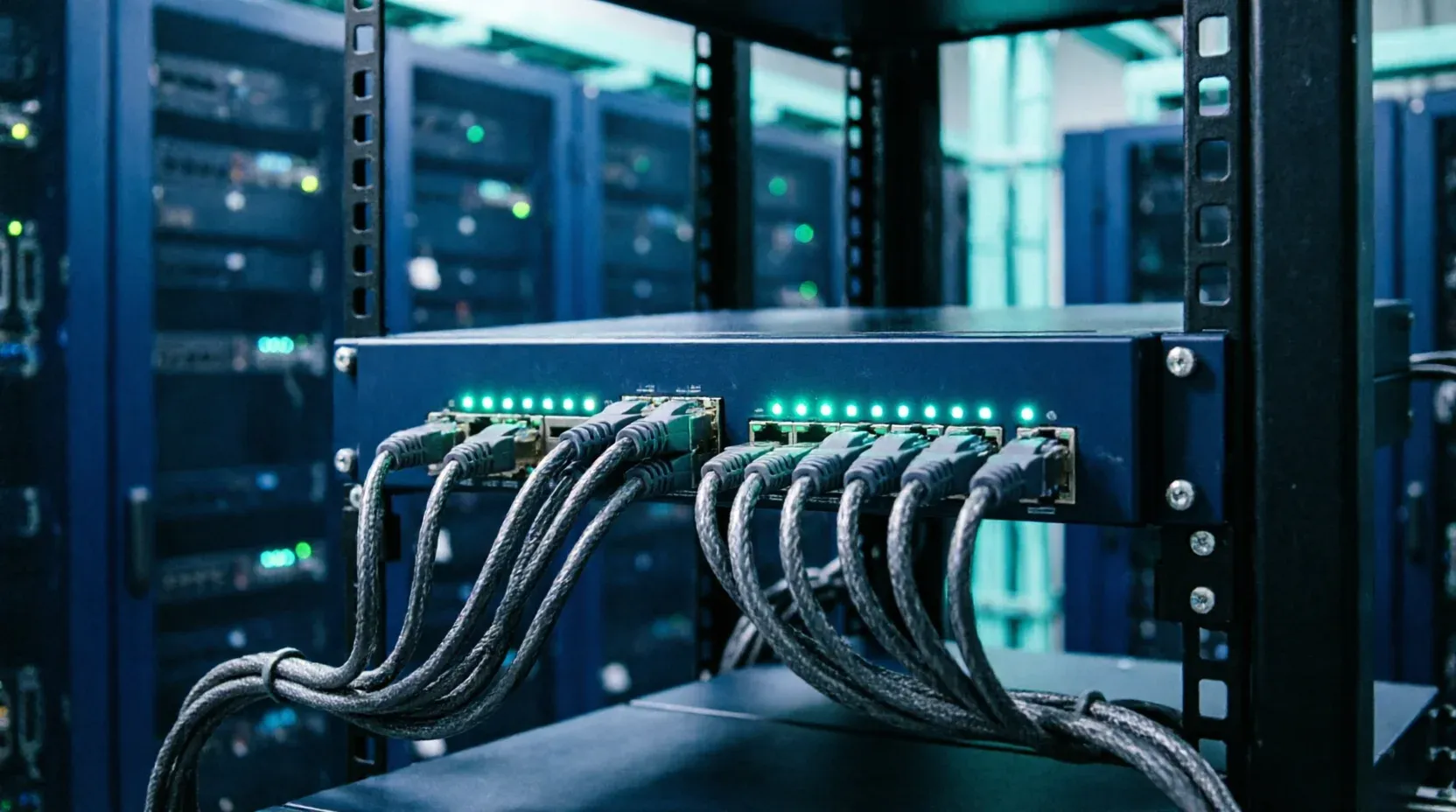
Arista Networks has introduced the 7060XE7 Series, a new portfolio of 1.6 terabit (1.6T) networking platforms designed specifically to serve as the foundation for rack-scale AI infrastructure. As AI workloads scale from thousands to hundreds of thousands of XPUs, Arista is shifting the network's role from a standalone layer of infrastructure into a critical, integrated backplane for a tightly-coupled AI supersystem. This transition allows the 7060XE7 Series to address the extreme density, power, and thermal efficiency requirements of the AI era, enabling customers to build both scale-up and scale-out AI fabrics optimized for air, liquid, and hybrid-cooled environments to maximize compute density per kilowatt of power.
Arista 7060XE7 Series Hardware and Thermal Configurations
The 7060XE7 Series provides a broad range of fixed switch platforms and configurable rack-scale systems, allowing for flexible system counts per rack to support various vertical and horizontal AI workflows. These platforms are engineered to provide low-latency and intelligent packet buffering, which is essential for managing the intense microbursts and collective communication patterns typical of AI workloads, ensuring consistent high-performance connectivity for compute and memory semantics both intra-rack and inter-rack.
The portfolio includes several distinct configurations to accommodate different data center cooling and density requirements:
- 7060XE7-64PS and 7060XE7-64PRS: These are air-cooled systems in a 4RU form factor. They provide deployment flexibility by supporting both Integrated heat sink (IHS) and Riding heat sink (RHS) optics.
- 7060XE7-64PRS-RV3-L: This is a specialized 2OU liquid-cooled platform designed for high-density clusters. It utilizes 224G SerDes and draws DC power from the ORv3 rack. To maximize power efficiency and integrate seamlessly with liquid-cooled XPU servers, this system omits internal fans entirely.
- 7060XE7-128PE: This platform offers 128 800G ports in an air-cooled 4RU design. It utilizes 100G SerDes to provide environments with necessary backward compatibility and deployment flexibility.
The series leverages the latest SerDes technology to provide high-speed bandwidth of 100 Terabits/sec and 1.6 terabits/sec throughput per port, ensuring signal integrity across the rack. To address the critical need for power efficiency, the platforms support Linear Pluggable Optics (LPO), which Arista states reduces interconnect power consumption by approximately 60%, thereby lowering the total cost of ownership.
Integration with Broadcom Silicon and AMD Compute
The transition to 1.6T networking is supported by a strategic ecosystem of silicon and NIC providers. Arista is collaborating closely with AMD on next-generation compute silicon and NICs to enable scale-out AI fabrics. According to AMD, this partnership helps advance the Ethernet networking ecosystem to enable flexible, high-performance AI fabrics built on open standards, giving customers choice across the full compute stack from CPUs and GPUs to unifying software solutions.
Simultaneously, Arista is utilizing Broadcom's Tomahawk 6 102-Tbps Ethernet switches. This 15-year partnership has resulted in an integrated system architecture that unlocks the on-chip resources and features of the Tomahawk 6 silicon. By combining this hardware with Arista EOS or Open NOS, the switches act as a unified rack-scale radix for high-density compute in both air and liquid-cooled AI environments.
These platforms are designed to support diverse AI accelerators and have gained support from major cloud providers:
- Microsoft: Rani Borkar, President of Azure Hardware Systems and Infrastructure, noted that the 1.6T Ethernet interface enables greater interconnect capacity for Microsoft's AI accelerator, Azure Maia, and its Fairwater extreme-scale AI datacenters while preserving operational simplicity.
- Oracle Cloud Infrastructure: Mahesh Thiagarajan, Executive Vice President, stated that these platforms provide the throughput, determinism, and stability required for Oracle's RDMA-based AI fabrics.
- Meta: Gaya Nagarajan, Vice President of Infrastructure, highlighted that the 1.6T platforms and liquid-cooled designs align with Meta's focus on open, scalable AI fabrics for next-generation training and inference.
Arista EOS Software Features for AI Resilience
The 7060XE7 Series is designed to support both Arista EOS (Extensible Operating System) and open Network Operating Systems, providing cloud titan customers with operational flexibility. The software suite includes a rich set of "Smart AI" features focused on congestion management, fabric resilience, and versatility:
- Load Balancing: The systems employ Dynamic Load Balancing (DLB) and Cluster Load Balancing (CLB) to optimize traffic distribution across the fabric and manage job completion times.
- Fabric Resiliency: To address the "failure amplifier" challenge—where a single link flap could stall a massive training job—the platforms support Multipath Reliable Connection (MRC). This is complemented by Link Layer Retry (LLR) to maintain performance stability at the physical layer.
- Congestion Management: The series includes PFC-aware DLB, PFC-aware ECN, and telemetry to provide granular visibility into network health and prevent head-of-line blocking.
- Feedback Mechanisms: Hardware-level feedback is handled via Congestion Signaling (CSIG) and Fast CNP to resolve congestion issues rapidly.
- Diagnostics and Uniformity: Integration with NetDI (Network Diagnostics Infrastructure) provides a uniform method for accessing device telemetry and diagnostics. Meanwhile, PDI (Platform-Dependent Infrastructure) manages low-level hardware specifics for each platform, facilitating software portability across different hardware architectures.
Availability and Deployment Timeline
Arista has provided the following availability schedule for the 7060XE7 Series:
- 7060XE7-64PS/PRS (64x 1.6T Air-Cooled): Expected Q4 2026.
- 7060XE7-64PRS-RV3-L (64x 1.6T Liquid-Cooled): Expected Q1 2027.
- 7060XE7-128PE (128x 800G Air-Cooled): Expected Q1 2027.
Key Takeaways
- The 7060XE7 Series introduces 1.6T throughput per port and utilizes LPO to reduce interconnect power consumption by roughly 60%.
- The portfolio includes a specialized 2OU liquid-cooled platform (7060XE7-64PRS-RV3-L) designed for integration with liquid-cooled XPU servers.
- Hardware is powered by Broadcom's Tomahawk 6 102-Tbps Ethernet switches and is designed to support diverse accelerators, including Microsoft's Azure Maia.
TechInsyte's Take
The shift toward rack-scale integration and liquid-cooled networking signals a move away from treating the network as a separate layer and toward treating it as a tightly coupled component of the AI supersystem. For infrastructure leaders, the primary consideration will be the transition to 1.6T standards and the associated power and thermal management requirements. Buyers should monitor the actual deployment timelines for the liquid-cooled variants, as these are not expected until early 2027.
Source: Businesswire