
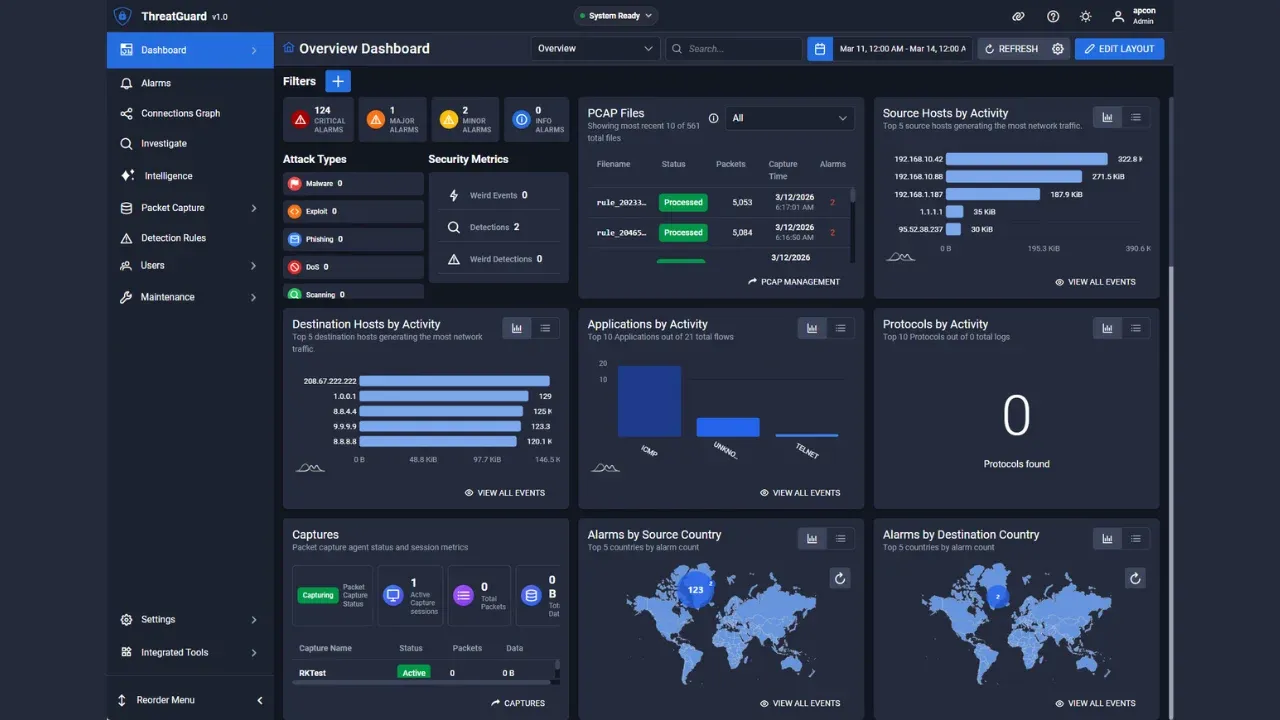
APCON, Inc. announced the release of ThreatGuard, an AI‑assisted platform that consolidates network monitoring, deep packet inspection, and investigation tools into a single environment. Designed for security teams of any size, ThreatGuard aims to reduce the need for multiple point solutions by providing real‑time alerts, visual investigation workflows, and mobile access.
The Update
ThreatGuard combines real‑time threat detection, deep packet inspection, traffic and intrusion analysis, and AI‑assisted investigation. Alarms, network traffic, packet evidence, and session metadata are presented in a unified workspace, allowing analysts to move from alert to response without switching tools. Integrated dashboards display alarms, files, applications, and network activity, while built‑in workflows help connect events, evidence, and impacted systems.
Technical Context
The platform’s deep packet inspection includes signature‑based detection and stateful protocol analysis, delivering visibility into applications and traffic patterns that some tools miss. An AI component, APCON’s Intelligence Processor (AIp), supplies automated rule updates to keep detection policies current without manual effort. ThreatGuard also offers a Connection Graph that visualizes relationships among hosts, sessions, and alerts, and a dynamic Connections Graph that maps device and traffic flows.
Deployment flexibility is a core feature: ThreatGuard can run on APCON’s IntellaStore hardware appliance or as standalone software in on‑premises or cloud environments. A feature‑rich mobile app for Apple and Android devices provides real‑time notifications and remote alert monitoring. The platform is offered to authorized users with a 30‑day evaluation period.
Enterprise Impact
By unifying monitoring, analysis, and response, ThreatGuard reduces tool sprawl and the associated operational overhead for security operations centers (SOCs). The AI‑driven rule updates aim to lower the burden of maintaining detection signatures, potentially accelerating time‑to‑investigation. Visual connection graphs can help analysts prioritize incidents and trace lateral movement more efficiently, which is valuable for organizations with complex network topologies.
The mobile app extends visibility to administrators working offsite, supporting the growing need for remote security management. Support for both appliance‑based and software‑only deployments gives enterprises the choice to align the solution with existing infrastructure strategies, whether they favor on‑premises control or cloud scalability.
Buyer Considerations
- Integration: Evaluate how ThreatGuard’s unified workspace fits with existing SIEM, SOAR, or ticketing systems to avoid duplicate data pipelines.
- AI Rule Updates: Confirm the frequency and scope of AIp‑generated rule updates and whether they align with your organization’s compliance and change‑management policies.
- Deployment Model: Determine whether the IntellaStore appliance or a software‑only installation best matches your performance, latency, and scalability requirements.
- Evaluation Period: Leverage the 30‑day trial to assess detection coverage, false‑positive rates, and the usability of the Connection Graph in your environment.
Key Takeaways
- APCON introduced ThreatGuard, an AI‑assisted platform that merges real‑time detection, deep packet inspection, and investigative tools.
- The solution offers both hardware (IntellaStore) and software‑only deployment options, plus a mobile app for remote monitoring.
- AIp provides automated rule updates, and visual Connection Graphs aim to streamline incident analysis.
TechInsyte's Take
ThreatGuard reflects a broader trend toward consolidating network security functions into a single, AI‑enhanced interface. For CIOs and security leaders, the platform’s promise of reduced tool fragmentation and automated rule maintenance could translate into lower operational costs and faster response cycles. However, the true value will depend on how well the AI‑generated rules align with an organization’s specific threat landscape and compliance mandates, and on the ease of integrating ThreatGuard with existing security stacks. Decision‑makers should pilot the solution, scrutinize its detection efficacy, and verify that its deployment model fits their architectural roadmap before committing to broader rollout.
Source: Businesswire