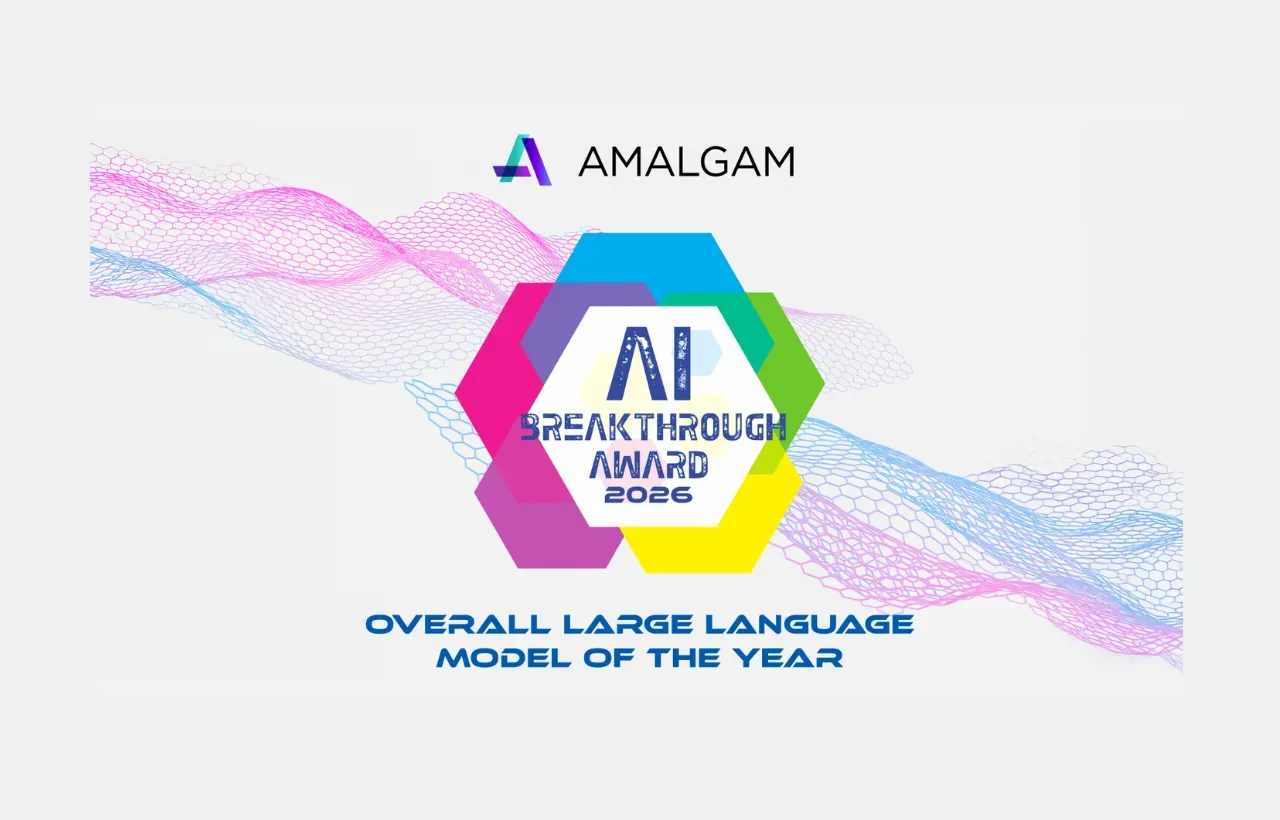
Amalgam Rx, Inc. has been named the winner of the “Overall Large Language Model of the Year” award at the ninth annual AI Breakthrough Awards. The honor recognizes Amalgam’s proprietary foundation model, Chiron, for predictive patient intelligence and marks the model as the most impactful LLM in the global AI industry for 2026. The award is especially noteworthy because the AI Breakthrough program—now in its ninth year and the longest‑running AI‑only recognition initiative—received more than 5,000 nominations from leading AI companies across more than 20 countries, making this the most competitive field in its history. Past winners have included industry powerhouses such as NVIDIA, Snowflake, Intuit, Dell Technologies, and Deloitte, underscoring the prestige of the accolade. For health‑system CIOs, CTOs, and data leaders, the win signals that a unified, production‑ready LLM is gaining traction as a solution to the fragmented, disease‑specific AI landscape that has long hampered longitudinal patient insights.
Amalgam Rx Receives AI Breakthrough’s Top LLM Award
AI Breakthrough announced that Amalgam Rx’s Chiron was selected as the most impactful large language model (LLM) in the global AI industry. The 2026 AI Breakthrough Awards drew over 5,000 nominations from AI companies in more than 20 countries, creating the most competitive slate the program has ever seen. Steve Johansson, managing director of AI Breakthrough, explained that most healthcare AI solutions remain “disease‑specific … resulting in a fragmented ecosystem where critical longitudinal patterns … remain invisible.” He highlighted Chiron’s “innovative foundation‑model architecture, large‑scale longitudinal data, and deep clinical integration” as the differentiators that earned it the top honor. Johansson’s comments reflect a broader industry consensus that a single, unified model could replace the patchwork of siloed tools that currently dominate clinical decision support.
Chiron’s Architecture and Clinical Integration
Chiron is described as an autoregressive transformer trained on millions of de‑identified, longitudinal patient records. The model treats the patient journey as a unified sequence of tokenized clinical events—diagnoses, medications, referrals, comorbidities, and demographics—rather than building separate pipelines for each condition. This design enables the model to surface early signals for multiple conditions simultaneously and to predict the next medical event across therapeutic areas. In the source material, a sleep‑apnea pilot demonstrated that Chiron delivered “nearly a 2x improvement in diagnostic efficiency … while reducing unnecessary diagnostic follow‑ups by nearly half,” illustrating how a single model can outperform traditional disease‑specific tools.
The architecture is deliberately built for production deployment. Chiron can be embedded directly into electronic health‑record (EHR) workflows across major health systems, delivering predictions at the point of care and continuously refining them through real‑world feedback. Amalgam emphasizes that this “production‑grade environment” cannot be replicated by academic or standalone AI solutions, which often remain in research or pilot phases. Partners already rely on Chiron to identify patients for targeted therapies and clinical trials, and its adherence‑risk predictions aim to intervene before treatment failure occurs, thereby extending the model’s utility beyond diagnosis to ongoing care management.
Enterprise Relevance for Health‑System Leaders
For CIOs, CTOs, and CDOs, Chiron’s unified approach promises to reduce the operational overhead associated with maintaining multiple disease‑specific AI pipelines. By consolidating data ingestion, model training, and validation into a single foundation model, health‑system IT teams could streamline infrastructure requirements, simplify governance, and lower total cost of ownership. The model’s real‑time integration with EHRs also aligns with the growing demand for point‑of‑care decision support that does not rely on batch‑mode analytics, enabling clinicians to act on risk insights instantly.
Ryan Sysko, CEO of Amalgam Rx, emphasized that the model “gives providers a comprehensive view of risk they’ve never had before and opens a wider window for intervention.” Bharath Sudharsan, Chief Data Scientist and Head of AI at Amalgam, added that training on “millions of real patient records across therapeutic areas” enables the capture of “complex temporal relationships that rules‑based systems and shallow machine learning simply cannot see.” These statements suggest that Chiron is positioned for enterprise‑scale deployment rather than research prototyping—a key consideration for organizations evaluating AI investments, especially those that must meet regulatory, security, and scalability standards.
Key Takeaways
- Amalgam Rx’s Chiron was named “Overall Large Language Model of the Year” by AI Breakthrough, selected from over 5,000 nominations across 20+ countries.
- Chiron is an autoregressive transformer trained on millions of longitudinal, de‑identified patient records, enabling simultaneous risk prediction across multiple conditions.
- In a sleep‑apnea pilot, Chiron achieved nearly a 2× improvement in diagnostic efficiency and cut unnecessary follow‑ups by almost 50%.
TechInsyte's Take
The award underscores that a unified, production‑ready LLM is gaining traction in the healthcare AI space, offering a potential path to reduce the complexity of managing multiple disease‑specific models. However, Amalgam has not disclosed broader deployment metrics or integration timelines beyond the cited sleep‑apnea results. Health‑system leaders should monitor real‑world performance data as the model scales across additional therapeutic areas and evaluate the effort required to embed Chiron within existing EHR ecosystems.
Source: Businesswire