


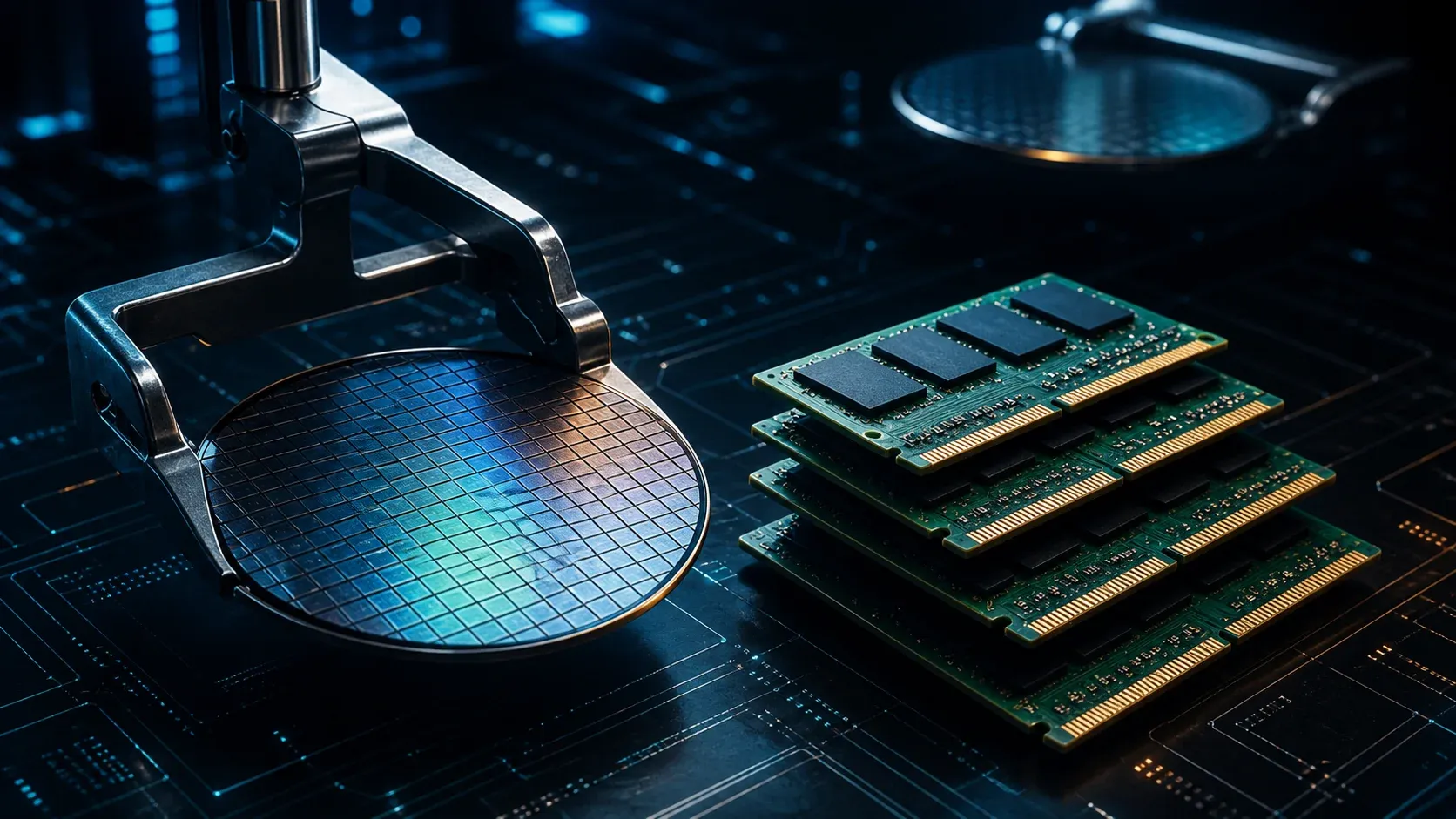
The artificial intelligence boom is no longer just increasing demand for GPUs. It is reshaping the entire semiconductor supply chain.
In 2026, high-bandwidth memory, server DRAM, enterprise SSDs, and AI-optimized chips are becoming strategic bottlenecks for cloud providers, AI labs, hardware companies, and enterprise infrastructure buyers. Samsung Electronics said its Memory Business surpassed its quarterly sales record by addressing high-value-added AI demand, while limited supply and industry-wide memory price increases also supported performance.
For B2B technology leaders, this means AI infrastructure planning can no longer focus only on cloud contracts or software capability. The physical chip supply chain now directly affects AI cost, availability, and deployment timelines.
Samsung’s Q1 Results Show the Scale of AI Memory Demand
Samsung’s first-quarter 2026 results show how strongly AI demand is flowing into semiconductor earnings.
Samsung said its Device Solutions division posted KRW 81.7 trillion in consolidated revenue and KRW 53.7 trillion in operating profit for the first quarter. The company said memory sales were supported by high-value-added AI demand, limited supply availability, and memory price increases.
Its official earnings presentation also reported KRW 133.9 trillion in total revenue and KRW 57.2 trillion in operating profit for the quarter, describing the performance as record quarterly revenue and operating profit driven by AI technology innovations and proactive market response.
That is the semiconductor story in miniature: AI demand is pushing customers toward premium memory products, while supply constraints are giving memory makers stronger pricing power.
SK hynix Is Also Benefiting From the AI Memory Cycle
SK hynix, a major supplier of high-bandwidth memory used in AI systems, also reported record quarterly performance.
The company announced first-quarter 2026 revenue of KRW 52.5763 trillion, operating profit of KRW 37.6103 trillion, and net profit of KRW 40.3459 trillion. SK hynix said the record performance was driven by increased sales of high-value-added products amid strong AI demand.
This matters because HBM has become one of the most important components in AI accelerators. AI chips need massive memory bandwidth to move data quickly during training and inference. Without enough HBM, even the most advanced accelerators cannot be deployed at full scale.
The Shortage Risk Could Extend Into 2027
Reuters reported that Samsung warned chip shortages could worsen in 2027 because demand is rising faster than production capacity can expand. The report said Samsung has signed multi-year contracts to secure long-term chip supply and is raising capital expenditure plans, especially around HBM.
This is a crucial point for enterprise buyers. Semiconductor factories take years to build and qualify. Demand can spike quickly, but supply cannot instantly respond.
Reuters also reported that SK hynix shares rallied after major U.S. technology companies signaled stronger AI spending plans, with Big Tech expected to spend more than $700 billion on AI initiatives in 2026. The same report noted that Microsoft and Meta reported higher-than-expected capital expenditure partly because of rising memory chip prices.
In plain terms: AI capex is turning into chip demand, chip demand is turning into memory tightness, and memory tightness is feeding back into AI infrastructure costs.
Why HBM Is the Center of the Bottleneck
High-bandwidth memory is not ordinary memory. It is stacked vertically, placed close to AI accelerators, and designed to move massive amounts of data at high speed.
That makes it essential for AI servers, but also harder and more capital-intensive to manufacture than many standard memory products. As chipmakers allocate more capacity to HBM and server memory, other parts of the memory market can also tighten.
This ripple effect matters for more than hyperscalers. Server manufacturers, cloud providers, AI startups, enterprise IT buyers, and even device makers may face higher component costs or longer procurement timelines.
AI Infrastructure Is Becoming a Supply-Chain Strategy
For technology companies, the AI boom is making procurement strategy more important.
A company building AI infrastructure must secure GPUs or accelerators, memory, networking components, storage, power systems, cooling infrastructure, and data center capacity. A shortage in any one layer can slow the whole stack.
This is why the semiconductor cycle is now directly tied to cloud economics. If memory prices rise, AI server costs rise. If AI server costs rise, cloud providers may adjust pricing, restrict capacity, or prioritize large customers with long-term commitments.
For enterprises, that means AI strategy should include vendor resilience, region availability, long-term capacity planning, and workload efficiency.
The Business Takeaway
The AI race is becoming a semiconductor race.
Samsung and SK hynix’s record results show that AI demand is flowing into high-value memory products. Reuters’ reporting on shortage risk shows that supply may remain tight even as chipmakers invest aggressively.
For TechInsyte readers, the key insight is clear: AI infrastructure is not only a software or cloud story. It is a deep hardware supply-chain story.
The companies that can secure memory, accelerators, data center power, and long-term supplier relationships will be better positioned to scale AI. Everyone else may discover that the next AI bottleneck is not intelligence. It is inventory.
FAQ
Why is AI increasing demand for memory chips?
AI systems need high-speed memory to move large volumes of data between processors during training and inference. HBM is especially important for advanced AI accelerators.
Which companies are benefiting from AI memory demand?
Samsung and SK hynix both reported record or sharply stronger semiconductor results in Q1 2026, driven by AI-related memory demand.
Why does this matter for enterprise AI buyers?
Tight semiconductor supply can increase AI infrastructure costs, reduce cloud capacity availability, and extend procurement timelines.
Source Pack
- Samsung Electronics Q1 2026 results: official source for Samsung’s semiconductor performance, AI-related memory demand, DS Division revenue, and operating profit.
- Samsung Q1 2026 earnings presentation: official source for record quarterly revenue, operating profit, and AI technology-driven growth.
- SK hynix Q1 2026 financial results: official source for SK hynix record quarterly revenue, operating profit, and AI memory demand.
- Reuters on Samsung chip profit and shortage warning: trusted third-party source for memory shortage risk, HBM demand, and 2027 supply concerns.
- Reuters on SK hynix and AI spending: trusted source for investor response, Big Tech AI spending signals, and memory price pressure.
